Virginia Home Grown
Tips for Growing Moss
Clip: Season 26 Episode 7 | 5m 17sVideo has Closed Captions
Discover native moss varieties and tips for their care
Peggy Singlemann explains why moss can be a better groundcover than turf and highlights several varieties native to Central Virginia. Featured on VHG episode 2607, September 2026.
Problems playing video? | Closed Captioning Feedback
Problems playing video? | Closed Captioning Feedback
Virginia Home Grown is a local public television program presented by VPM
Virginia Home Grown
Tips for Growing Moss
Clip: Season 26 Episode 7 | 5m 17sVideo has Closed Captions
Peggy Singlemann explains why moss can be a better groundcover than turf and highlights several varieties native to Central Virginia. Featured on VHG episode 2607, September 2026.
Problems playing video? | Closed Captioning Feedback
Where to Watch Virginia Home Grown
Virginia Home Grown is available to stream on pbs.org and the PBS app.
Providing Support for PBS.org
Learn Moreabout PBS online sponsorshipAnd, Serome, I have something semi-related to all of this because of the shade factor, okay?
It's moister, it's cooler.
And with our weather here, it's perfect >>Oh yeah.
>>for growing mushrooms, but also for growing moss.
>>And they go hand in hand.
>>They do go hand in hand.
And so many people, they get so frustrated because they can't grow grass underneath their shade, their shade trees, and in the part shade.
And my attitude is let it go.
>>Exactly.
Sometimes it's better to not fight with mother nature.
>>Exactly.
And if you have moss, just encourage it.
And if you're not, then bring it on in.
But here's some of our common mosses that I've found close by to home here.
And one of them is here this hairycap moss, and it actually grows to a number of inches tall.
>>Yeah, it looks like little pine trees.
>>It does, isn't it?
>>Own little forest.
>>It does.
And you know, mosses are very simple plants.
They don't have a vascular system.
So, this one here has this very rudimentary system for moving water all the way up >>Mm-hmm.
>>that super tall stem there.
>>Right.
Yeah.
(Peggy laughing) >>But then we have a creeper called a fern moss, and this fern moss loves the moisture and just creeps along in the shade to part shade.
>>Mm-hmm.
>>And what makes it adhere to places are its rhizoids, which are thread-like structures.
>>Yes.
So, it's not like a root system.
It's just basically to hold it down.
>>Truly, because again, mosses get all of their nutrients, their moisture from the air.
And guess what else they do?
They clean the air and they sequester carbon for us.
>>See, a win-win.
>>Win, win, win.
Unlike a lawn, which uses so many inputs, the fertilizer, the pesticides, the water, the seeding, on and on.
>>Yeah.
And if you want to grow moss too, you got to remember, you don't want to use any of that stuff along with the moss.
They just do not like it.
>>Gosh, no.
No.
But we have another moss that does not like any sunshine at all.
It's called a spoon moss and these little leaves are wrapped around its stem, like little spoons lined up.
And that's a fun one.
Again, a slow spreader.
But then we have one >>Mm-hmm.
>>that people are familiar with, a mounder, called a cushion moss.
>>Cushion moss.
>>Yes.
>>So, you just see little mounds >>Yup.
>>just growing on the side of trees and on hillsides.
>>Exactly.
And it gets to be a nice dome and it can come in a dark green, a light green, or even a silver green.
So, they're all those cushion mosses.
>>And imagine all of them put together and you can make a tapestry.
>>Yes, you can, you can.
Be beautiful.
And then, finally, there's the feather moss here, which is, I took that from my house personally, because it's growing all over my brick walkway.
(Serome chuckles) And- >>Yes.
So, this one, I know loves growing on hardscapes.
I've remembered days >>Mm-hmm.
>>of having to scrape them off of stairwells and everything.
So, they do like hard surfaces.
>>They do.
And again, we have rhizoids which are connecting them, >>Mm-hmm.
>>those thread-like structures because they don't have roots.
So, it's perfect for that kind of environment to grow on (laughs) >>Mm-hmm.
>>as much as we want it.
But it also shares that you need to, for care of the moss, you do need to weed it, okay?
And I know both of us want to pull these weeds to make it nice and clean, (Serome laughing) but we're gonna resist.
(chuckles) But you do need to weed your moss and you don't want to rake your moss because that'll just rake it all up.
>>Yeah, it's a lot easier on them to have a blower.
>>Mm-hmm.
>>There is specialized, if you have a huge moss lawn, there are specialized blowers that are on wheels so that it's close to the ground and will blow things away instead of blowing directly at it.
So, it limits the damage that could happen if you're blowing air directly on it and you start >>Truly.
>>filling up the moss.
>>But if you don't, just put your blower on low.
>>Yep, exactly.
>>Okay?
Take it easy and be kind.
Now, people who want to extend their moss or even start a moss garden, there's an old wives' tale of buttermilk and water (Serome chuckles) and a moss in a blender.
And I'll be honest, I tried that decades ago and it just doesn't work.
>>It doesn't work.
>>Okay?
But what you can do is buy your moss from a reputable dealer.
Please don't go out >>Yes.
>>and harvest in the woods.
>>And go harvest.
>>Yeah, these are all from a friend's house.
But what you want to do is clear the area.
Don't till the soil.
Leave it hard because they like hard surfaces, >>Mm-hmm.
>>rocks, logs, bare soil.
And then, put moisture down, lay your moss sheets down.
And then, I would suggest putting a netting over it to keep the wildlife.
>>Yes.
Birds would love going through and start grabbing it, >>Mm-hmm.
Squirrels.
>>nesting >>Mm-hmm.
>>and everything else.
>>Right.
But then just like any other plant, you need to water it regularly for a few weeks >>Mm-hmm.
>>until it takes.
And don't be dismayed if it turns brown because many of these kind of go dormant.
>>Give it a little water >>And once- >>and guess what?
>>Greens back up.
>>It revives itself.
And- >>Yup.
>>And I use moss for a lot of projects too.
So, I've even built moss propagation bins where you just have a bin and I would drill holes in the bottom for the drainage and put down like a gravel layer or chicken grit layer >>Mm-hmm.
>>just to put the moss on and I can set it aside in the shade and just let the moss spread.
And then, I have moss there for projects that I'm using it for.
>>That is awesome.
See, it's good for projects.
It makes a beautiful green carpet for a shady or part shade area.
And I just think it's undervalued and- >>Yeah, it's just beautiful.
>>It is beautiful.
And it makes it... Think of all those gardens worldwide >>Oh yes.
>>that are covered in moss.
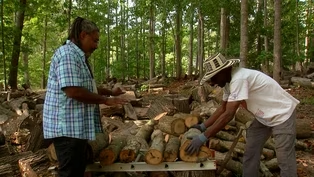
Growing Shiitake Mushrooms on Logs
Video has Closed Captions
Clip: S26 Ep7 | 7m 42s | Discover techniques for cultivating mushrooms in a natural environment (7m 42s)
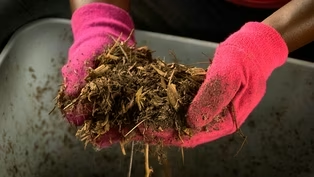
How to Amend Soil with Wood Chips
Video has Closed Captions
Clip: S26 Ep7 | 3m 19s | Learn tips for improving your garden soil with wood chips (3m 19s)
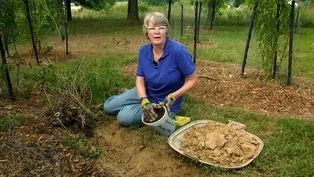
Video has Closed Captions
Clip: S26 Ep7 | 3m 23s | Give your garden beds a boost with mushroom compost (3m 23s)
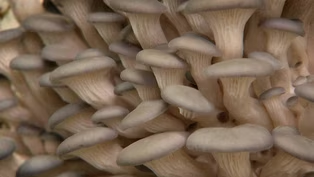
Video has Closed Captions
Clip: S26 Ep7 | 7m 55s | Meet mushroom farmers growing a variety of gourmet shrooms indoors (7m 55s)
Video has Closed Captions
Clip: S26 Ep7 | 5m 44s | Learn how to create unique mushroom inspired sculptures for your garden (5m 44s)
Providing Support for PBS.org
Learn Moreabout PBS online sponsorship














Support for PBS provided by:
Virginia Home Grown is a local public television program presented by VPM