
Under a Shared Sky
Clip: Season 17 Episode 10 | 8m 53sVideo has Audio Description
Ancestral Lakota belongings return home after 170 years.
Nearly 170 years after a devastating attack at Blue Water Creek, sacred belongings taken from Sicangu Lakota families have finally returned home. In this powerful Nebraska Stories episode, descendants of both the Lakota victims and a U.S. Army officer come together in a journey of remembrance, reconciliation, and healing.
See all videos with Audio DescriptionADProblems playing video? | Closed Captioning Feedback
Problems playing video? | Closed Captioning Feedback
Nebraska Stories is a local public television program presented by Nebraska Public Media
Under a Shared Sky
Clip: Season 17 Episode 10 | 8m 53sVideo has Audio Description
Nearly 170 years after a devastating attack at Blue Water Creek, sacred belongings taken from Sicangu Lakota families have finally returned home. In this powerful Nebraska Stories episode, descendants of both the Lakota victims and a U.S. Army officer come together in a journey of remembrance, reconciliation, and healing.
See all videos with Audio DescriptionADProblems playing video? | Closed Captioning Feedback
How to Watch Nebraska Stories
Nebraska Stories is available to stream on pbs.org and the free PBS App, available on iPhone, Apple TV, Android TV, Android smartphones, Amazon Fire TV, Amazon Fire Tablet, Roku, Samsung Smart TV, and Vizio.
Do you have a Nebraska Story?
Do you have a story that you think should be told on Nebraska Stories? Send an email with your story idea, your name, your city and an email address and/or phone number to nebraskastories@nebraskapublicmedia.org. Or, click the link below and submit your information on nebraskastories.org.Providing Support for PBS.org
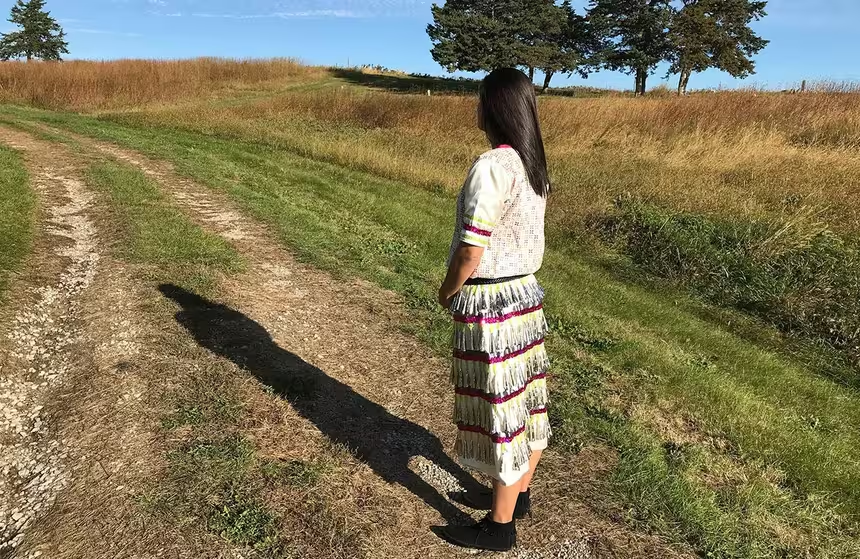
Learn Moreabout PBS online sponsorship(serene music) -[Narrator] The stillness of this late summer pasture bears no scars from the tragic event that took place years ago.
On a September morning in 1855.
(serene music) 600 U.S.
Army troops attacked some 200 Sicangu Lakota camped along Blue Water Creek.
(serene music) A family village led by Chief Little Thunder.
(serene music) The assault was ordered in retaliation for the killing of Lieutenant John Grattan and 29 soldiers a year earlier.
A confrontation that began over a Mormon immigrants lame cow and spiraled into violence.
(serene music) The raid began before sunrise.
Within two hours, 86 men, women and children lay dead.
Survivors were taken captive, held as bargaining power in negotiations with the Great Sioux Nation.
(serene music) The September 3rd, 1855, attack was led by General William S. Harney, an Army officer whose brutality in the Second Seminole War earned him the title Indian Fighter.
(serene music) After the massacre of Blue Water, the Lakota gave him a new name (serene music) woman killer.
(serene music) As the dead lay scattered across the prairie.
Lieutenant Governor K. Warren of the Corps of Topographical Engineers gathered the belongings of Chief Little Thunder's band, sparing some from General Harney's order to burn the camp.
(serene music) Recognizing their anthropological value, he worked until the evening, selecting items and loading wagons.
(serene music) These objects became the earliest Plains Indian artifacts in the Smithsonian's collection and remained there for 170 years.
(wind rustling) This 250 year old cottonwood stood on the prairie the day the Little Thunder Camp was attacked.
(wind rustling) Today, it's known as a witness tree.
(wind rustling) Each September, the Sicangu Lakota gather here to pray on the anniversary of the massacre.
(wind rustling) (native music) -[Karen] Very few of our family know about the massacre.
(native music) My two greats grandfather was the leader, Chief.
My one one great grandfather is the survivor of the Blue Water massacre.
And he is buried at home.
(serene music) -[Narrator] Karen Little Thunder is a member of the Sicangu Lakota and lives on the Rosebud Sioux Reservation in South Dakota.
For years, she's worked to bring attention to the Blue Water Creek Massacre.
(serene music) -[Karen] This has been so heavy and hard on my heart for so long.
And then I meet people who say, well, that was in the history.
What's it got to do with me?
That was long ago.
But truth is, that's um.
(serene music) It's there.
They don't.
(serene music) Education.
I want to keep this about education, that's all.
(serene music) -[Narrator] While a student at Sinte Gleska University, Karen learned of a book featuring Lakota artifacts in the Smithsonian.
(serene music) It turned out to be a record of the items Lieutenant Warren collected at the Blue Water Creek Massacre.
(serene music) -[Karen] So the doll to me represents a little girl.
(serene music) This little doll (serene music) I just on site became attached to it.
(serene music) -[Narrator] Since Karen first learned of what became of her relatives belongings.
The burden of that history has remained.
But the story didn't end there.
(serene music) -[Paul] My ancestor was General William Selby Harney, who committed the massacre of 86 Lakota people here at Blue Water.
(serene music) -[Narrator] More than a decade ago.
Paul Soderman began reaching out to the Little Thunder family.
(serene music) -[Paul] The Lakota concept of forgiveness is different than the English or the Western.
(serene music) I mean, there are some similarities, but it's an actual work called wokintunze.
(serene music) -[Philip] People talked about Harney Peak and Black Hills and said, hey, I know somebody that's descendant of General Harney.
Maybe he can do something about that mountain.
(serene music) -[Narrator] Over time, Paul Soderman formed a trusting friendship with Philip, Karen and other Lakota tribal members.
(native music) That relationship led to a united effort to rename Harney Peak in South Dakota.
(native music) Today, the mountain bears the name Black Elk Peak, honoring a Lakota holy man.
(native music) -[Philip] We talked about other things and (native music) always mentioned September 3rd.
I said, you know, why don't we just ask for that stuff back and bring it back?
(serene music) -[Karen] We started drafting some documents, and I shared those with Paul and Cathy, and they made the adjustments and submitted them, and that was the ask.
(serene music) -[Narrator] The ask came as a Smithsonian adopted a new ethical collections policy focus on how artifacts were acquired.
Objects seem to have been taken without consent, stolen or obtained under duress would be returned to the rightful owners.
(serene music) -[Karen] I was in disbelief for a very long time.
(serene music) It means that I am able to be in the presence of my relatives and my ancestors.
-[Philip] We call them woyuha (serene music) in Lakota language, sacred word.
(serene music) That means they're part of who they are.
(native drum music) (machine whirling) -[Narrator] Though the Little Thunder belongings were taken from Blue Water Creek in the aftermath of the massacre.
Their return was marked with dignity and long awaited healing.
(native chanting) Now., the ancestral belongings of Little Thunder's band are home, again.
(serene music) -[Philip] We did things collectively.
We tried to get everybody involved and (serene music) the word "we" was always there.
(serene music) -[Paul] It takes a long time to build the trust, but once you build that trust, you can move forward together.
(serene music) The Lakota word for it is taku wakan skan skan.
And what that means is something sacred is in motion here.
-[Karen] Looking now at what's happening.
(serene music) It's like I can breathe now.
(serene music) (insects buzzing)
















Support for PBS provided by:
Nebraska Stories is a local public television program presented by Nebraska Public Media