
Under A Shared Sky & More
Season 17 Episode 10 | 26m 31sVideo has Audio Description
Ancestral Lakota belongings return homes, Lincoln's global competition Gravel Worlds and more.
Ancestral Lakota belongings return home after 170 years, Lincoln's global competition Gravel Worlds, the science of art restoration, and the ancient history of Signal Butte. Nearly 170 years after they were taken, personal belongings of Sicangu Lakota families were returned to their descendants under the museum’s updated ethics policy. Founded in 2008 by a small group of friends.
See all videos with Audio DescriptionADProblems playing video? | Closed Captioning Feedback
Problems playing video? | Closed Captioning Feedback
Nebraska Stories is a local public television program presented by Nebraska Public Media
Under A Shared Sky & More
Season 17 Episode 10 | 26m 31sVideo has Audio Description
Ancestral Lakota belongings return home after 170 years, Lincoln's global competition Gravel Worlds, the science of art restoration, and the ancient history of Signal Butte. Nearly 170 years after they were taken, personal belongings of Sicangu Lakota families were returned to their descendants under the museum’s updated ethics policy. Founded in 2008 by a small group of friends.
See all videos with Audio DescriptionADProblems playing video? | Closed Captioning Feedback
How to Watch Nebraska Stories
Nebraska Stories is available to stream on pbs.org and the free PBS App, available on iPhone, Apple TV, Android TV, Android smartphones, Amazon Fire TV, Amazon Fire Tablet, Roku, Samsung Smart TV, and Vizio.
Do you have a Nebraska Story?
Do you have a story that you think should be told on Nebraska Stories? Send an email with your story idea, your name, your city and an email address and/or phone number to nebraskastories@nebraskapublicmedia.org. Or, click the link below and submit your information on nebraskastories.org.Providing Support for PBS.org
Learn Moreabout PBS online sponsorship(upbeat music) -[Narrator] Coming up on Nebraska Stories.
Taken during a historic 1855 massacre.
Lakota belongings come home.
A gravel road race where grit meets speed and anyone can ride.
An iconic painting gets a facelift.
and Signal Butte offers clues to early Native American life.
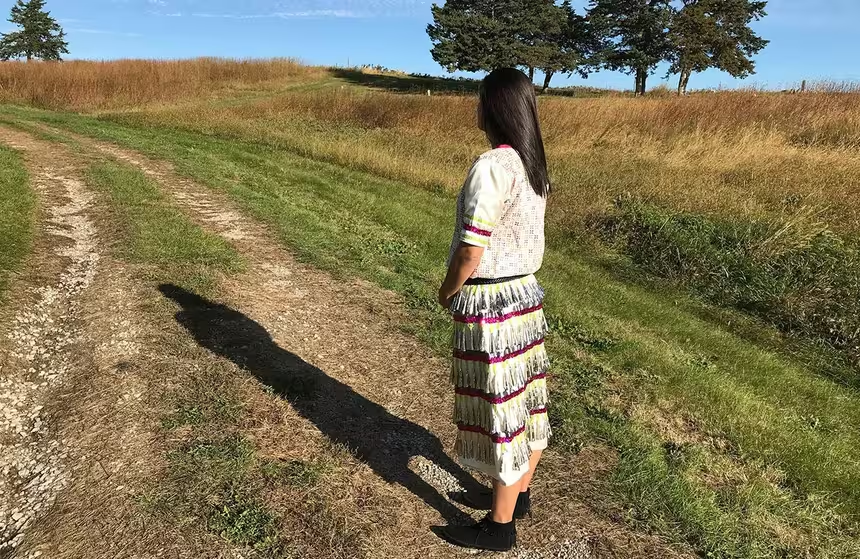
(upbeat music) (upbeat music) (serene music) -[Narrator] The stillness of this late summer pasture bears no scars from the tragic event that took place years ago.
On a September morning in 1855.
(serene music) 600 U.S.
Army troops attacked some 200 Sicangu Lakota camped along Blue Water Creek.
(serene music) A family village led by Chief Little Thunder.
(serene music) The assault was ordered in retaliation for the killing of Lieutenant John Grattan and 29 soldiers a year earlier.
A confrontation that began over a Mormon immigrants lame cow and spiraled into violence.
(serene music) The raid began before sunrise.
Within two hours, 86 men, women and children lay dead.
Survivors were taken captive, held as bargaining power in negotiations with the Great Sioux Nation.
(serene music) The September 3rd, 1855, attack was led by General William S. Harney, an Army officer whose brutality in the Second Seminole War earned him the title Indian Fighter.
(serene music) After the massacre of Blue Water, the Lakota gave him a new name (serene music) woman killer.
(serene music) As the dead lay scattered across the prairie.
Lieutenant Governor K. Warren of the Corps of Topographical Engineers gathered the belongings of Chief Little Thunder's band, sparing some from General Harney's order to burn the camp.
(serene music) Recognizing their anthropological value, he worked until the evening, selecting items and loading wagons.
(serene music) These objects became the earliest Plains Indian artifacts in the Smithsonian's collection and remained there for 170 years.
(wind rustling) This 250 year old cottonwood stood on the prairie the day the Little Thunder Camp was attacked.
(wind rustling) Today, it's known as a witness tree.
(wind rustling) Each September, the Sicangu Lakota gather here to pray on the anniversary of the massacre.
(wind rustling) (native music) -[Karen] Very few of our family know about the massacre.
(native music) My two greats grandfather was the leader, Chief.
My one one great grandfather is the survivor of the Blue Water massacre.
And he is buried at home.
(serene music) -[Narrator] Karen Little Thunder is a member of the Sicangu Lakota and lives on the Rosebud Sioux Reservation in South Dakota.
For years, she's worked to bring attention to the Blue Water Creek Massacre.
(serene music) -[Karen] This has been so heavy and hard on my heart for so long.
And then I meet people who say, well, that was in the history.
What's it got to do with me?
That was long ago.
But truth is, that's um.
(serene music) It's there.
They don't.
(serene music) Education.
I want to keep this about education, that's all.
(serene music) -[Narrator] While a student at Sinte Gleska University, Karen learned of a book featuring Lakota artifacts in the Smithsonian.
(serene music) It turned out to be a record of the items Lieutenant Warren collected at the Blue Water Creek Massacre.
(serene music) -[Karen] So the doll to me represents a little girl.
(serene music) This little doll (serene music) I just on site became attached to it.
(serene music) -[Narrator] Since Karen first learned of what became of her relatives belongings.
The burden of that history has remained.
But the story didn't end there.
(serene music) -[Paul] My ancestor was General William Selby Harney, who committed the massacre of 86 Lakota people here at Blue Water.
(serene music) -[Narrator] More than a decade ago.
Paul Soderman began reaching out to the Little Thunder family.
(serene music) -[Paul] The Lakota concept of forgiveness is different than the English or the Western.
(serene music) I mean, there are some similarities, but it's an actual work called wokintunze.
(serene music) -[Philip] People talked about Harney Peak and Black Hills and said, hey, I know somebody that's descendant of General Harney.
Maybe he can do something about that mountain.
(serene music) -[Narrator] Over time, Paul Soderman formed a trusting friendship with Philip, Karen and other Lakota tribal members.
(native music) That relationship led to a united effort to rename Harney Peak in South Dakota.
(native music) Today, the mountain bears the name Black Elk Peak, honoring a Lakota holy man.
(native music) -[Philip] We talked about other things and (native music) always mentioned September 3rd.
I said, you know, why don't we just ask for that stuff back and bring it back?
(serene music) -[Karen] We started drafting some documents, and I shared those with Paul and Cathy, and they made the adjustments and submitted them, and that was the ask.
(serene music) -[Narrator] The ask came as a Smithsonian adopted a new ethical collections policy focus on how artifacts were acquired.
Objects seem to have been taken without consent, stolen or obtained under duress would be returned to the rightful owners.
(serene music) -[Karen] I was in disbelief for a very long time.
(serene music) It means that I am able to be in the presence of my relatives and my ancestors.
-[Philip] We call them woyuha (serene music) in Lakota language, sacred word.
(serene music) That means they're part of who they are.
(native drum music) (machine whirling) -[Narrator] Though the Little Thunder belongings were taken from Blue Water Creek in the aftermath of the massacre.
Their return was marked with dignity and long awaited healing.
(native chanting) Now., the ancestral belongings of Little Thunder's band are home, again.
(serene music) -[Philip] We did things collectively.
We tried to get everybody involved and (serene music) the word "we" was always there.
(serene music) -[Paul] It takes a long time to build the trust, but once you build that trust, you can move forward together.
(serene music) The Lakota word for it is taku wakan skan skan.
And what that means is something sacred is in motion here.
-[Karen] Looking now at what's happening.
(serene music) It's like I can breathe now.
(serene music) (insects buzzing) ♪ ♪ (upbeat music) -[Jason] It's going to be a fun show.
There's going to be some dirt.
There might be some walking, but here we go.
(upbeat music) Ten.
Nine.
Eight.
Seven.
Six.
Five.
Four.
Three.
Two.
One.
Lauf Gravel Worlds 2025 has begun!
(upbeat music) This gravel world belongs to you.
It belongs to people.
It's not a race.
It's not an event.
It's an experience that when you do these really hard efforts, it's a memory that you will have for a lifetime.
We had just under 2500 participants this year, from almost all 50 states and 27 countries from all six inhabited continents.
And that is divided up between our triathlon, our running, but our biggest section is our cycling events.
Which puts us into one of the largest gravel events in the world.
The top five, top ten every single year.
(upbeat music) -[Sophia] Oh, it's full speed ahead from beginning to end.
I mean, it's only what, 1:40 and I almost have 20,000 stops, so I'm probably going to get 40,000.
By the end of the day.
(upbeat music) -[Volunteer] Yeah.
-[Sophia] Could you take them over to that green Good Life tent?
-[Volunteer] Yeah.
-[Sophia] This is the week that we all live for.
Because it's so special to be able to put on an event that's worthy of people's time and energy and money.
In and out.
(upbeat music) (crickets chirping) (upbeat music) And we are expecting probably about 5 to 6000 people total at this event.
We've always said we want Gravel Worlds to look like the world, and that means everyone, no matter who they are, what they believe, where they're from, they are here at Gravel Worlds.
(people chatting) -[Scott] According to the MC it looks like this is the biggest 75 race that they ever had.
So look at all the people.
(people chatting) -[Jason] Let's go Lauf Gravel Worlds!
(clinking and cattle bells) -[Scott] 1,500 feet of climbing already.
Get that.
So a lot of up and downs.
Nebraska is definitely not flat.
- It's wrinkly.
(group laughing) - Wrinkly.
That's perfect.
- And I thought it was beautiful too.
Like, I came into it thinking lots of cornfields out there, but there was a lot of other beautiful terrain that kind of mixed it up, too.
And I thought it was interesting.
-[Geoffrey] There's Scott Baumann.
Woo!
We've done a lot, and I would say that this is definitely in the top tier of organized (upbeat music) -Woo!
Great Job.
-[Geoffrey] Thank you, Nebraska, for having a well-positioned gravel race.
(group laughing) And a beautiful state.
(upbeat music) (crunching gravel) -[Jason] We're really proud of the impact that Gravel Worlds has.
We did a community impact study that showed we bring over $2.5 million into Lincoln and Nebraska.
(insects chirping) The big thing that Gravel Worlds has done is shown that Nebraska is not a flyover state.
It's a place that is beautiful and is challenging to go experience on a bike, (gravel crunching) but really shows off the beauty of our land, the kindness of our people.
(wind and crunching gravel) Gravel Worlds started in 2010 with a bunch of friends and a parking lot.
There was about 100 people at the first event.
So it's pretty crazy to see the growth of this event in such a relatively short amount of time, but also just the growth of the sport of gravel cycling.
It started right here in the Midwest and now has become a global sport.
-{Reporter] Congratulations Rosa!
How was the mud at the beginning?
-[Rosa] Wow.
It was quite tough.
I must say... -[Jason] The type of participants that we have is a very drastic difference.
(cheering and cattle bells) From kids, our youngest rider we had this year was eight years old.
Our oldest rider was 82 and riders from all over the world.
But then also different ability levels.
We have the pro riders who some have ridden in, like the Tour de France at that level.
A lot of them, this is their full time job where they are professional athletes.
(upbeat music) -[Joe] You know, it's way up there in terms of competition with what they've done for us this year.
So it's a chance to race really good racers.
So.
(upbeat music) The most challenging part of my day was myself underestimating what that little rain shower did.
Going into it, it wasn't too bad, but right before we got out of it, it just turned into peanut butter mud and a guy crashed in front of me.
I crashed and then someone else landed on me.
And then my bike got all clogged up with mud.
(upbeat music) Then you kind of shift mindsets and you're like, just ride hard.
Other people are going to have problems too.
We'll group up,come together, ride really strong and then we ended up finishing 19th on the day for myself.
(upbeat music) -[Announcer] Joe Goetti.
(upbeat music) (cheering) So to come back from that after losing so much time early on.
Was a, yeah, good way to overcome that a little bit, and make something of it.
(upbeat music) I think it's kind of cool to highlight both experiences.
Like me I'm at the point in the men's professional race, and she's doing her second ever gravel race.
(upbeat music) -[Kendra] So this year I decided to take on the double half, which included a 25 K run, and then the next day, a 75 mile bike ride.
(upbeat music) But for me, like once we started, I just focused on my ride and what that was gonna entail and met some amazing people along the way.
Supporting me in times that I really needed to hear that.
So that was really cool to have and so competitive.
But everyone was just also having a great time.
(upbeat music) (serene music) (crowd cheering) -[Jason] Our celebration for our last place finisher is bigger than our first place finisher.
So this year we had 40 bottles of champagne that we sprayed on our last place.
We have a finish line party where we invite the whole community to come in to the finish line and celebrate all those people that are out there for 13, 14, 15 hours.
I would say that's the biggest aspect that's different with gravel is this that camaraderie, that community competitive and noncompetitive alike, are treated the same, and we can all come together at the end and can proud of what we finished and celebrate every single person.
-[Announcer] Well done to John Starrs from Omaha.
Well done Randy.
-[Jason] I hope that all of our participants walk away with a memory that they're proud of.
Whether their day went perfectly or they did not finish.
(serene music) - Good.
-[Jason] I hope they learn something about themselves.
(serene music) Make a new friend.
- Love it.
- Awesome.
Get it!
-[Jason] Make a new memory (serene music) and leave inspired to maybe do it again or do something even harder.
Themselves when they leave.
(serene music) t music) (pensive piano music) NARRATOR: Let's start with the painting.
It's called "The First Homestead," and that's what it depicts.
The artist is Gusto Strohm, who lived in Beatrice near the site of Daniel Freeman's homestead claim.
Painted in 1888, likely working off a photograph.
KENNETH BE: It's a very honest attempt to reproduce what we know of the first homestead.
NARRATOR: The painting took a beating, for a while, tucked behind a door in a U.S.
congressman's office, before landing in Kenneth Be's lab at the Ford Conservation Center.
There are problems, like large tears and small holes, a brittle canvas pulling loose at the edges, and lots of dark grime and soot.
MIKE TOBIAS: Remount, clean it, make it brighter, fix the holes, varnish it, all in the next month.
KENNETH: All in the next month, you'll see a big difference.
We want to, number one, make sure that work of art survives past our generation and forward into the next generation, but we also wanna make sure it's presented in the best way possible, as the artist would have originally intended.
So here, we have the canvas, which has now been removed from its old wooden stretcher.
I've also prepared these areas, where there were tears and the canvas was buckling, with weights, where I've had overnight flattening going on, so that we can now line the painting and have these tear areas aligned properly.
NARRATOR: Adhesive is helped by a heated table and vacuum to attach the painting to a new reinforced canvas.
(soft pensive music) KENNETH: So I'm about to start cleaning this painting.
(soft pensive music) NARRATOR: Getting rid of decades of exposure to black soot.
KENNETH: This darkening of the picture has sort of illusionistically compressed the image.
We no longer have that sense of space that the painting was meant to have at one time when you looked at it.
(soft pensive music) NARRATOR: Be's also filling those tears in the canvas.
(soft pensive music) KENNETH: By varnishing, I'm adding a protective layer, but aesthetically, I'm adding a layer that fills in that prime and pitted surface, and gives a nice even saturation, and a slight gloss to the painting.
MIKE: This will bring out some of the colors-- KENNETH:It will.
MIKE: And the feel.
KENNETH:Not only will it even out the sky, but it'll especially saturate and darken all the dark foreground terrain.
(bright pensive music) MIKE: How hard is it to match that color?
KENNETH: What I actually see is not just one color, but it's a whole sequence of colors.
I'm trying to create the same illusion that the original painting has of layering little wisps of color.
And I'm using pigment and paint medium, which is easily removable.
NARRATOR: That, plus a lot of testing, provides a safety net.
But to me, working on another artist's creation, owned by someone else, would be nerve-wracking.
KENNETH: One of the skills that I've developed is knowing what not to do, knowing the battles to pick, knowing where to stop and knowing my limits, and even conservation can have limits.
And so, we owe it to the artist and also the owner of the work of art to know what we can't do for them.
So that's how I stay out of trouble.
MIKE: So you're done.
KENNETH: Yes, the painting treatment is finished, and now we can see it much better, as it was originally intended.
(soft piano music) NARRATOR: Gusto Strohm's "The First Homestead" leaves refreshed for display at the Homestead National Monument.
Be moves on to more paintings in need of new life.
KENNETH: I think art conservation is very important because we only have the material heritage, the artwork, the historic artifacts that we inherited, that have come to us down through history.
I love it, I love art conservation, and it's what I do.
♪ ♪ (gentle music) (birds chirping) -[Narrator] In the western part of Nebraska, iconic landmarks like Chimney Rock, (gentle music) (birds chirping) Scotts Bluff Monument, (gentle music) and Courthouse and Jail Rock dominate the landscape.
(gentle music) Yet, a lesser known butte lies quietly in the shadows of these giants.
(gentle music) (birds chirping) Nestled in Scotts Bluff County, Signal Butte stands as a watchful presence over the plains, holding secrets that date back thousands of years.
(gentle music) (birds chirping) Designated a national historic landmark in 1961, this site is one of Nebraska's most significant archeological treasures.
(gentle music) (birds chirping) Rising about 120 feet above the plains at the western edge of the Wildcat Hills, Signal Butte has captivated archeologists for nearly a century.
(gentle music) Its layered history is encapsulated in the gravel and windblown soil that cover it.
(gentle music) (car engine whirring) The historical discoveries of Signal Butte began in 1931 when archeologists from the Smithsonian Bureau of American Ethnology, in collaboration with the University of Nebraska Archeological Survey Field Party, conducted the first official excavations.
(gentle music) They uncovered not just artifacts, but windows into the lives of those who inhabited this land thousands of years ago.
(gentle music) Three distinct cultural horizons were identified at Signal Butte, with the two deepest layers dating from 5,000 to 1,500 years ago.
(gentle music) These layers revealed stone projectile points, bone tools, (gentle music) and the remnants of ancient hearths and storage pits.
(gentle music) The significance of Signal Butte extends beyond its artifacts.
It was one of the first sites in the world to use the groundbreaking radiocarbon dating method, helping to establish a timeline for human activity in the region.
(gentle music) In the 1940s and 50s, archeologists from the University of Nebraska Lincoln returned to further explore the site, deepening our understanding of the prehistoric peoples who once roamed the Central Plains.
(gentle music) Though Signal Butte sits on private land and might not be widely known to most Nebraskans, its towering presence and the secrets it holds preserve the history of those who lived here long ago.
(gentle music) (upbeat music) (upbeat music) - [Narrator] Watch more Nebraska stories on our website, Facebook and YouTube.
Nebraska Stories is funded in part by the Margaret and Martha Thomas Foundation, and the Bill Harris and Mary Sue Hormel Harris Fund for the presentation of cultural programming.
(upbeat music) (upbeat music) (upbeat music) (upbeat music)
 New
NewVideo has Audio Description
Clip: S17 Ep10 | 8m 53s | Ancestral Lakota belongings return home after 170 years. (8m 53s)
Providing Support for PBS.org
Learn Moreabout PBS online sponsorship















Support for PBS provided by:
Nebraska Stories is a local public television program presented by Nebraska Public Media