
Training Belugas and Salting the Tanks at the Shedd Aquarium
Clip: Special | 4m 7sVideo has Closed Captions
Meet the people who keep the Shedd Aquarium’s animals healthy and the tanks salty.
Geoffrey Baer feeds the whales at the Shedd Aquarium, where he meets a trainer who shares her love of the belugas. And we meet the operator who makes 9,000 gallons of salt water per day.
Problems playing video? | Closed Captioning Feedback
Problems playing video? | Closed Captioning Feedback
Chicago Tours with Geoffrey Baer is a local public television program presented by WTTW
Training Belugas and Salting the Tanks at the Shedd Aquarium
Clip: Special | 4m 7sVideo has Closed Captions
Geoffrey Baer feeds the whales at the Shedd Aquarium, where he meets a trainer who shares her love of the belugas. And we meet the operator who makes 9,000 gallons of salt water per day.
Problems playing video? | Closed Captioning Feedback
How to Watch Chicago Tours with Geoffrey Baer
Chicago Tours with Geoffrey Baer is available to stream on pbs.org and the free PBS App, available on iPhone, Apple TV, Android TV, Android smartphones, Amazon Fire TV, Amazon Fire Tablet, Roku, Samsung Smart TV, and Vizio.
(gentle music) - Just hanging out with the guitarfish here and the sharks.
The Shedd Aquarium is one of the most popular attractions in Chicago.
This is what 2 million people a year see.
Let's check out what they don't see.
As the sun rises hours before guests arrive, it's breakfast time for the Shedd Aquarium's beluga whales, and they have big appetites.
Senior trainer Angie Soliai makes sure each whale gets exactly the right amount of their favorite frozen seafood.
Who's this for?
- This is for Kimalu.
- Kimalu.
Okay.
- In there.
(bucket clattering) Perfect.
We are gonna do herring for Annik, and he gets 10 kilos.
- [Geoffrey] Wow.
(fish clattering) You definitely have to not mind fish smell, right?
- I mean, after a while you just don't smell it anymore.
For sure.
- It's a squid.
(laughs) Oh my gosh!
I'm gonna have nightmares.
(upbeat music) Now comes the fun part.
(whale squeaking) There you go.
- There you go.
- All right, here, just take the whole bunch there.
There you go.
- Very nice.
- [Geoffrey] Michele August is one of many Shedd trainers who spend hours each day bonding with the belugas.
- How we doing?
(whale squeaking) They understand what we're asking based on how we move our hands and bodies.
- Oh my gosh!
- Nice job, buddy.
Do you wanna try giving him a hand signal?
- What do I do?
- You're gonna take your right hand and you're gonna pretend like you're pulling down on a string, okay?
- Okay.
- All right.
- Right now?
- Go ahead, right now.
(whale trumpeting) Yeah!
Good job!
- Oh my gosh!
- Very nice.
Very nice.
- Now, that's not just for putting on a show, right?
- Right.
Our number one reason for training them is so that we can take better care of them.
So in a position like this, if you wanna step forward a little bit more.
- Uh-huh.
Okay.
- I'm gonna tip him on his side.
So in this position, we could actually do a voluntary ultrasound exam.
- [Geoffrey] Belugas are salt water creatures, but the Shedd sits on the shores of Lake Michigan.
So where do you get millions of gallons of salt water when you're 800 miles from the nearest ocean?
Well, back when the Shedd opened in 1930, salt water was imported from Key West, Florida on railroad tank cars.
They ran on a dedicated track through what is now the museum campus.
Today, the Shedd makes its own seawater using the same product you can buy in pet stores, except they buy it in one ton bags.
Operator Maurice Smith makes 9,000 gallons a day.
That's a hazard of the job, right?
- [Maurice] Yes it is.
- [Geoffrey] So you don't have high blood pressure, do you?
- No.
(laughs) - [Geoffrey] It's a bad job for somebody with high blood pressure.
- Yes it is.
Yes it is.
- That much salt.
You have an aquarium at home?
- Yes.
Yes.
- You do?
- Well, that's what kind of, I was happy to come here because I've had aquariums since I was a little kid.
- Oh really?
- Yeah.
Since I was like about five or six, my dad brought a tank home, and I've been in love with fish ever since.
So coming here was like a dream.
And when we change water from a fish system, we can send it to the oceanarium.
- [Geoffrey] Maurice also monitors the computers that control a huge network of pumps and valves, distributing that seawater throughout the aquarium.
Just like the Shedd's visitors, these aquatic animals have no idea about all the systems behind the scenes that allow them to thrive, but they do know those curious human creatures who shower them with love and food every day.
Have you always been interested in animals?
- Absolutely, yeah, I was definitely an animal person from the very beginning.
- [Geoffrey] You seem to just love.
- I do.
There's nothing quite like them.
It's very special.
(bright music)
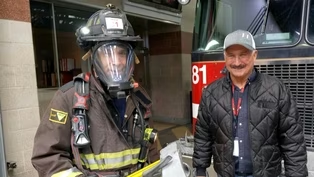
Behind the Scenes of "Chicago Fire"
Video has Closed Captions
Clip: Special | 6m 14s | Geoffrey Baer gets a behind-the-scenes look at the set of "Chicago Fire." (6m 14s)
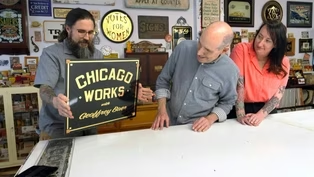
The Chicagoans Reviving Gold-Leaf Sign Painting
Video has Closed Captions
Clip: Special | 3m 28s | Andrew and Kelsey McClellan have revived the delicate, nearly-lost art of gold-leaf sign painting. (3m 28s)
Preview: Special | 1m 11s | Chicago is known as the city that works. Geoffrey Baer explores the city’s unique jobs. (1m 11s)
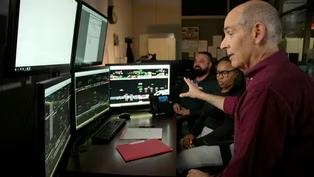
The Control Center that Keeps Metra on Track
Video has Closed Captions
Clip: Special | 4m 58s | Every day, Metra’s busy control center directs 700 commuter trains across 11 lines. (4m 58s)
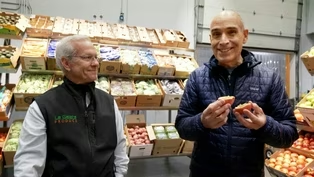
Early Mornings at the Chicago International Produce Market
Video has Closed Captions
Clip: Special | 4m 18s | While Chicago sleeps, employees at the International Produce Market start their day. (4m 18s)

Faking Fire on the Set of "Chicago Fire"
Video has Closed Captions
Clip: Special | 4m 55s | How does the crew of “Chicago Fire” make a convincing – but safe – set? (4m 55s)
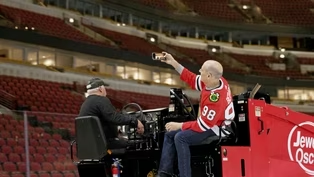
From Basketball Court to Hockey Rink at the United Center
Video has Closed Captions
Clip: Special | 4m 5s | It takes a quick crew to transform the United Center’s basketball court into a hockey rink. (4m 5s)
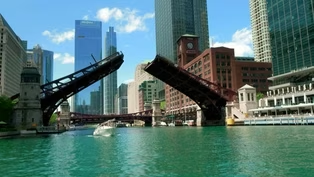
Inside a Chicago River Bridge House
Video has Closed Captions
Clip: Special | 4m 31s | It takes a whole team to lift a bridge on the busy Chicago River. (4m 31s)

The Keepers of the Chicago Rat Hole
Video has Closed Captions
Clip: Special | 4m 28s | What happened to the Chicago Rat Hole? One city department sought to preserve it. (4m 28s)
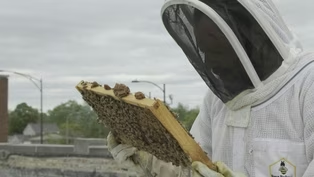
Meet a Rooftop Beekeeper on Chicago’s West Side
Video has Closed Captions
Clip: Special | 5m 52s | Thad Smith runs the Westside Bee Boyz on Chicago’s West Side. (5m 52s)
The Quiet Artistry of the Music Box Theatre's Projectionists
Video has Closed Captions
Clip: Special | 5m 56s | Meet the projectionists keeping movie magic alive at Chicago’s Music Box Theatre. (5m 56s)

Rat Race! Rodent Control in Chicago’s Alleys
Video has Closed Captions
Clip: Special | 3m 50s | Two rodent control workers patrol Chicago’s alleys looking for telltale signs of rats. (3m 50s)
Sorting Recyclables in Back of the Yards
Video has Closed Captions
Clip: Special | 5m 5s | Go inside a recycling facility in Chicago’s Back of the Yards neighborhood. (5m 5s)
The Staggering Logistics of a Suburban UPS Facility
Video has Closed Captions
Clip: Special | 3m 27s | Hodgkins, Illinois is home to the largest UPS ground sorting facility in the country. (3m 27s)
What Does It Take to Keep Wrigley Field Running?
Video has Closed Captions
Clip: Special | 5m 6s | Inside the Friendly Confines, a skilled crew keeps Wrigley Field running on game day. (5m 6s)
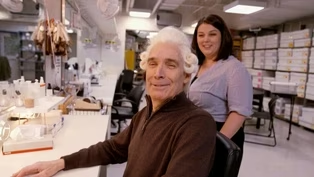
Wigs, Props, and Other Magic at the Lyric Opera
Video has Closed Captions
Clip: Special | 4m 59s | Meet a wigmaker, prop master, and conductor at the Lyric Opera. (4m 59s)
Providing Support for PBS.org
Learn Moreabout PBS online sponsorship














Support for PBS provided by:
Chicago Tours with Geoffrey Baer is a local public television program presented by WTTW