Here and Now
Here & Now for June 26, 2026
Season 2400 Episode 2450 | 26m 46sVideo has Closed Captions
Watch the entire episode of Here & Now for June 26.
Watch the entire episode of Here & Now for June 26.
Problems playing video? | Closed Captioning Feedback
Problems playing video? | Closed Captioning Feedback
Here and Now is a local public television program presented by PBS Wisconsin
Here and Now
Here & Now for June 26, 2026
Season 2400 Episode 2450 | 26m 46sVideo has Closed Captions
Watch the entire episode of Here & Now for June 26.
Problems playing video? | Closed Captioning Feedback
Where to Watch Here and Now
Here and Now is available to stream on pbs.org and the PBS app.
Providing Support for PBS.org
Learn Moreabout PBS online sponsorship>> The following program is a PBS Wisconsin Original production.
>> An outpouring of support shows up for the release of Salah Sarsour, a Milwaukee community leader detained by Ice, setting the stage for a free speech retaliation case against the US government and years of record breaking tourism in the state diverges from employer efforts to find seasonal help.
[MUSIC] I'm Shawn Johnson filling in for Frederica Freyberg tonight on here.
And now we speak with an ACLU attorney and former immigration judge working on Salah Sarsour case.
[MUSIC] And a new federal rule could put some of the most vulnerable at risk of losing Medicaid coverage.
We check in on the tourist season underway in Door County and in Milwaukee.
Columnist speaks to the end of an era as Giannis Antetokounmpo moves on to Miami.
It's "Here& Now" for June 26th.
>> Funding for here and Now is provided by the Focus Fund for Journalism and Friends of PBS Wisconsin.
>> After 80 days in federal custody, Salah Sarsour, a green card holder and president of the Islamic Society of Milwaukee, was released from a facility in Indiana.
Sarsour was arrested in a targeted operation on March 30th when he was surrounded by Ice agents, the U.S.
Department of Homeland Security, in a press release called Sarsour a criminal and a terrorist, alleging crimes committed in Israel more than 30 years ago prior to coming to the U.S.
and of which he denies.
Secretary of State Marco Rubio is reported to have said that Sarsour, quote, poses an adverse consequence to foreign policy considerations.
Sarsour is outspoken about the mistreatment of Palestinians in Gaza by Israel.
In the order granting the motion for his release, a federal judge stated, quote, Mr.
Sarsour has raised a substantial First Amendment retaliation claim which could render his detention unlawful.
Here to discuss the case is a member of Sarsour's legal team.
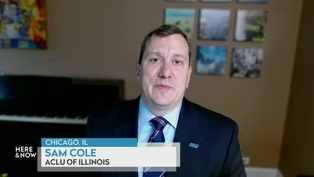
Sam Kohl, an attorney with the ACLU of Illinois who is also a former immigration judge.
Sam, thanks for joining us.
>> Thanks for having me.
>> You're familiar with the arguments raised by the Trump administration against Salah Sarsour.
The secretary of state himself said that he posed an adverse consequence to foreign policy considerations.
Were there grounds to arrest and detain him?
>> No.
Absolutely not.
Mr.
Sarsour has been a upstanding person in the United States since he came here over 30 years ago.
He is a grandfather of nine US citizen kids and has had absolutely no trouble in the United States.
The only reason he was arrested was because he's an outspoken advocate for Palestinian human rights, and that's why he's been targeted by this administration.
And that is absolutely not an appropriate and lawful reason to arrest someone.
>> So what were conditions like for Mr.
Sarsour in jail?
>> They're pretty bad.
He lost 30 pounds during the time that he was there.
He's also he also has some medical problems.
He's a type two diabetic, and his doctor required that he have daily glucose, blood glucose monitoring.
And he was getting tested once a month.
So that's that's not great.
And that could really pose some serious risks to his health.
>> Was there a chance he could have been deported?
>> So the case is ongoing.
Right.
So he so he has been released from detention based on our motion in front of a federal district court judge.
So Mr.
Sarsour filed a petition for a writ of habeas corpus, asking the federal judge to release him from from the immigration detention.
And the judge hasn't ruled on that habeas petition quite yet.
But he did grant an interim release of Mr.
Sarsour while the court adjudicates the habeas petition by saying that he's made a strong showing that he might prevail in in the habeas petition.
But that doesn't mean the immigration case is over.
So Mr.
Sarsour is still fighting deportation in immigration court, and that's ongoing.
>> Okay.
You're a former immigration judge yourself.
You've said this case is highly unusual.
You've never seen anything like it.
How much of the case is outside the bounds of what you'd normally see?
>> I was an immigration judge in the Chicago immigration court for nine years, and I handled, actually, a detained docket.
That's a docket of individuals who are in immigration custody.
So very similar to the situation that Mr.
Sarsour was in.
And Mr.
Sarsour's case is, in fact, in the Chicago immigration court.
And I can tell you, for one, I have never seen anything like this at all.
The first of all, the the primary charge against him is, as you noted, that letter from of Secretary of State Marco Rubio saying that.
NewsHour.
Suarez really lawful activity in the United States poses a foreign policy risk to the United States.
Now that that is highly unusual and highly legally dubious.
But the other thing that is extraordinary about this case is although the case is is assigned to the Chicago immigration court, the judge that was assigned to hear the case is not a Chicago immigration court judge.
It's actually a very senior level management judge in the in the executive Office for Immigration Review.
It's the an acting regional deputy chief immigration judge.
It's essentially the second in command of all the judges in the entire immigration court system.
So that case was plucked out of the immigration court judges and specifically assigned to this one management judge.
I've never seen that happen.
>> So I gather you feel like you have a strong, strong First Amendment case here that his rights, your client's rights were violated.
Can you explain that?
>> Absolutely.
Mr.
Sarsour, as a longtime permanent resident of the United States, has the same First Amendment rights to speak and to engage in political activity and political activism that that essentially you and I do as citizens of the United States.
And so what's really happening is, is the government is, is targeting him because they don't like his speech.
And that is is highly problematic.
It is it violates the Constitution, the First Amendment.
And, and we're very concerned to see this, this these charges against him by the administration.
>> So you mentioned this, that this case is not over.
You have hearings coming up.
How does this proceed?
What happens next?
>> So there's another hearing coming up.
The at the end of July, July 22nd, in the immigration court, where the government has the burden of proof.
In this case, they have to prove the charges that that they have made against him.
And and aside from the charges, based on the Marco Rubio determination about foreign policy, there are some other charges that relate to things that have been decades and decades ago, things the government has known about for a very long time.
And, you know, we are we will fight these charges.
We we are he has very good defenses, and we are fighting them in immigration court.
And if we lose in immigration court, we will continue our fight all the way up as far as it takes, because everyone knows what's going on here.
It's not about anything that happened decades ago.
It's about what he's doing now, his speech.
And that's why he's being that's why he's being targeted.
>> All right.
We'll be watching the case.
Sam Cole, thank you so much for joining us.
>> Thank you.
>> Changes to Medicaid eligibility in the One Big Beautiful Bill Act won't take effect until January, but advocates are worried that new work requirements could put coverage in jeopardy.
For many in Wisconsin, the new changes will apply to those who began receiving Medicaid when Wisconsin partially expanded the program.
Starting in 2027.
This group will have to work, volunteer or go to school 80 hours a month to maintain their coverage.
There are exemptions, such as for people considered medically frail, but the rules to prove that condition just got stricter.
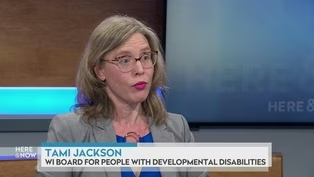
To unpack what this could mean, we're joined by Tami Jackson from the Wisconsin Board for people with Developmental Disabilities.
Tammy, thanks so much for joining us.
>> Thanks for having me.
>> So I'd like you to get a sense of the different groups of people that we're talking about here.
So first of all, when it comes to people who are subject to these new work requirements for Medicaid in Wisconsin, how large is that group here?
And can you give us a sense of their circumstances?
>> Sure.
The group of people that this applies to are folks in the BadgerCare plus program.
Wisconsin actually has many programs that are funded by Medicaid, but it only applies to the BadgerCare plus population and within BadgerCare plus, there are lots of different kinds of people, including some who we think will be subject to this new rule.
The Department of Health Services estimates about 200,000 people in BadgerCare plus will be potentially subject to this rule, and they're worried that about 63,000 are at high risk of losing their coverage.
And many of those people that may be at high risk of losing their coverage are people who either who may potentially fall into the medically frail exemption, but they may have a hard time proving that they are exempt.
And the new rule that was just released earlier this month gives some clarity, but also leaves a lot of questions unanswered for how people qualify to be exempt.
>> Can you explain that term medically frail as you understood it when this law was passed?
And then now, as it's being defined in these new federal rules?
>> Well, the the medically frail category in the law had a number of subcategories in it.
And when it was being debated, the law said, well, we intend to, you know, exempt people with disabilities, people with serious medical conditions, people that you might expect would have a hard time necessarily meeting a work requirement.
But as it turns out, the way that you proved that you meet one of these categories is harder than you think.
And it also relies it's not enough to be able to be in one of the categories.
You also have to prove that you cannot work those 80 hours as in the rule.
So it's kind of a double factor authentication where you have to prove you belong in a category, and you also prove that you can't work.
And this applies to people who are blind and disabled in, you know, that's one exemption category.
So somebody who's getting Social Security, SSDI or SSI, another category is people with serious mental illnesses.
A third category is people with physical, intellectual, developmental disabilities who have one or difficulty with one or more activities of daily living.
And then people who have a serious or illness, a serious medical condition.
And it looks like this rule leaves a lot of questions unanswered, both as to who fits and who doesn't fit in those categories, and what happens when you have somebody who's in that gray area where they can work some, but maybe not as much as 80 hours a month?
>> I'm just trying to imagine what it means to to go through that process.
If you do fit one of those categories of proving it, I mean, what, what are they going through just to take that step?
>> Well, and that's part of what is now falling to states to figure out the rule will allow you to kind of accept somebody's word for the first year.
But after that, you have to be able to document in an auditable way that you meet these categories.
And I think for many, many states, including our own, there's a mad scramble to try and figure out, well, how do you prove that you fit into one of these categories?
There are some ideas in the rule about using past billing data, for example, from Medicaid.
But we can see as advocates that there are lots of ways where people might not have access to the health care system to be able to get the diagnoses or documents they need.
And then it is really unclear how you prove that you cannot work those 80 hours, even if you fit into those categories.
>> When this law was passed, I mean, the argument was that taxpayers are going to underwrite a benefit.
People who receive it should be required to pitch in.
From your perspective, now that it's becoming kind of a reality, what does this miss?
>> Well, I think the first thing it misses is that two thirds of the people who are in a Medicaid program are already working.
So, you know, for a lot of people, this this now becomes a documentation problem to prove what they already have been doing.
And for other people who are working part time, you know, you now have a group of people who has to do more to keep their coverage.
What we know from other states that have tried similar experiments in the past is that work requirements don't actually lead to more people working.
What they do lead to is more people making paperwork, mistakes, or states making paperwork mistakes that cost people their health care coverage.
And that's particularly serious with the population of people who could qualify to be medically frail if they make a mistake and lose their health care coverage.
That could mean that they have an illness that isn't getting treated, that they lose care coverage that really could literally cost them their lives.
>> All right.
Certainly something we'll be watching.
Thanks so much for joining us.
>> Thanks for having me.
>> Wisconsin hit record breaking tourism numbers for 2025.
According to a new report, it was the fourth year in a row that it broke the previous high.
But a tourism boom is often accompanied by workforce challenges, with many areas relying on seasonal workers visiting with temporary visas.
So far this year, Wisconsin has received a fraction of the short term workers with an H2B visa that it has in the past.
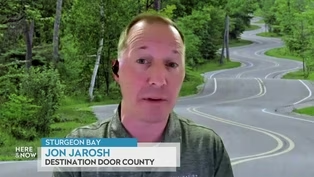
To see how the industry is faring this year, we turn to John Jon Jarosh, chief communications officer for Destination Door County.
John, thanks for joining us.
>> Yeah, good to be with you.
Thank you.
>> So I think it's fair to say that a lot of people will associate Door County with rest and relaxation, you know, putting all your worries behind you.
I wonder what these staffing shortages, how these door counting tourism businesses are feeling right now.
>> Yeah, we certainly had a few challenges with some of the H-2b visas that are work.
Our workers and our employers have been trying to get, because we really ramp up in the summertime as, as a lot of viewers may know, it takes a lot more workers than we have that live here to be able to, to operate our businesses and to maintain a level of service.
But I think most people have come to expect when they visit Door County.
And so our business owners have had to go to alternative methods to find enough workers to fill those needs.
And the primary one that we use here is the Summer work travel program, or a J-1 visa.
That's a fairly common one.
That program's been around for a long, long time.
And a more recent one that is used is what you had or you suggested or said the H-2b visa.
The numbers that of H-2b workers that we've had in the last couple of years pale in comparison to the number of J-1 visas that are here in Door County.
And so but nevertheless, the the H-2b visa is an important one for some of our businesses because those folks can stay longer.
They're not students, unlike the J-1 students that are here.
They have to be a student in order to qualify for J-1 visa.
So that means they're here for only a couple of months.
And Door County sees it now is a good, you know, five, six months long at that really that peak season.
And so some of our businesses have turned to the H-2 visa option, h-2b visa option because they can stay longer and they can stay through the entire season to make sure that they're being covered.
And we have enough workforce through the the fall season in October into November.
>> Okay.
So there are other parts of the state, maybe where the season is shorter and those shorter visas work, but the H-2b visas are more critical in Door County because it has a longer season.
Is that right?
>> Yeah, that is that's correct.
And our season has expanded here in the last 1020 years in Door County.
It really for for a long time, it was Memorial Day to Labor Day.
But that is no longer the case.
And so, you know, again, the J-1 visas this year, we're probably going to be in the neighborhood of about 560 of the summer work travel students.
And last year, I think we had maybe 85 to 90 H-2b visa workers that were in the county.
So again, much smaller numbers.
But increasingly, businesses have looked to that as an alternative to make sure that they have coverage longer in the season instead of that three months that those, you know, collegiate students that are here on the J-1 visa are can can stay.
>> So why have they slowed down these these visas?
>> There's a couple of reasons.
Certainly we're unsure exactly why.
I know there's been some challenges with some of the consulates.
There is actually a cap on the H-2b visa.
And so when that cap is reached, a lot of times businesses that may have put in a request for some h-2b visa holders and to come and work, they just, they, you know, the cap is hit and those are no longer available.
There's also a lottery system that is in play.
And if you draw a lottery number, I don't know exactly how that system works, but your chances of getting an h-2b worker are really slim, if not none.
And so again, it's a it's a much smaller percentage of our workforce here.
It's relatively new.
And so what we're learning this year is really what the needs of our constituents are, our employers, the businesses that have relied on them.
So we can use that as to help better advocate here in the next year.
Moving forward, the process to get either a J-1 visa student or an H-2b is quite lengthy.
It takes a long time, and so it's not something that you can just do over the course of a week or two.
And so we'll start to plan in our advocacy efforts will kick in later this summer, probably going into the fall when those processes need to start for the summer of 2027 already.
And so it, you know, we're learning and we're certainly going to be reaching out.
It's a federal issue since those visas are at a federal level, not at a state level.
And I'm sure we will talk amongst our tourism industry peers across the state of Wisconsin to figure out how we can better work together to advocate for the needs of our tourism industry from an employee standpoint, and particular with these visas.
>> So real quick, as we wrap up here with a lot of travelers staying closer to home due to high gas prices, can local destinations like yours handle another record breaking year?
>> Yes.
The short answer in Door County, I. I'm very confident that we can.
We are.
Because of our seasonal nature.
We are comprised of entrepreneurs up and down this peninsula and on Washington Island, and they always figure out a way to, to, to make it work one way or another.
You know, they may have to reduce hours a little bit to accommodate maybe a reduced workforce to some extent.
But rest assured, people can expect the same great service that they have or that they're used to when they come to Door County.
And it is shaping up, I think, to be another great summer.
Door County is a great place, really close to home, and yet it feels like you're a world away when you're here.
And we're anticipating another good year here in Door County and look forward to welcoming everyone.
>> All right, we'll leave it there.
Thanks so much for joining us.
>> My pleasure.
>> 13 years ago, the Milwaukee Bucks selected the youngest player in that year's NBA draft.
>> To be NBA.
NBA player.
>> Giannis Antetokounmpo.
A lanky 18 year old from Greece, was seen as a roll of the dice by a struggling small market franchise.
But Giannis grew up.
He put the bucks on his shoulders.
He won fans hearts, and he made Milwaukee a champion.
That love affair is over now.
After the bucks dealt Antetokounmpo to the Miami Heat.
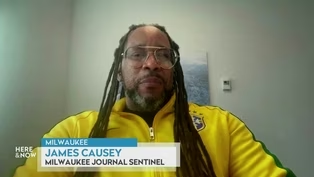
Here to discuss what Giannis meant to the city and where things went wrong is Milwaukee Journal Sentinel columnist James Causey James.
Welcome.
>> Hey, thanks for having me.
>> So I suppose it's an emotional time.
Any time that a star player like Giannis gets dealt for the fans.
But it just seems to me like he had such an attachment to the city of Milwaukee.
How would you characterize it.
And you know what did he mean to the city.
>> Well I like to put it to you this way.
Giannis was our son.
I mean he came to us as a young man very very young.
And the city wrapped his arms around him.
And he embraced us.
He was he was our unicorn.
He was a guy who got us a championship.
He was a guy who a funny story about him.
One time he was trying to get to the arena and he got lost, and somebody saw him on the side of the road and picked him up and dropped him off.
That's who Giannis is and that's who he was to us.
So losing Giannis is like losing a big part of of of our city.
He played for us for 13 years.
One of the longest reigns in the NBA.
And he's going to be dearly missed.
But it was it was time for him to pursue other endeavors.
>> It's sort of a thoughtful guy too, is he not the way he talks about success, being a journey and living in the moment?
>> Oh yeah, of course.
And you know, he was more than just a basketball player.
He also organized a diaper drive that was critical for young moms who needed diapers for their babies.
Him and his wife were very sponsored that he, he he was seen a lot in the community.
He was like I said, he was our son.
And and we embraced him and we loved on him.
And, you know, he got us our championship, our first championship in 50 years.
So that's something that can never be erased.
>> Yeah.
I mean, it strikes me that his story is such a perfect storm.
He got so much better, so fast.
And, you know, then this Milwaukee downtown was rebuilt.
You had this state of the art arena, the house that Jack built.
You won the championship.
It just seemed like everything was going so great.
So why did it fall apart?
>> Well, it fell apart because honestly, I believe it was a lot of bad moves by the bucks trying to keep the team above water.
That didn't work.
You know, the shuffling of coaches that just didn't work.
And what we're hearing now is like not keeping Giannis in the loop.
And he was a person who honestly wanted to be kept inside the loop.
He wanted to know what was going on going on.
What was the team's direction moving forward.
And it seemed like he was not privy to that type of information.
And for, for a young man who gave his heart and soul to the team and to the city, I. I wish that it could have been better and that communication should have been better.
And we know one thing he always wanted to win, and I think the bucks tried to satisfy that.
But at the same time, I think he should have been privy of the inside dealings that they were trying to do to make sure that that that happened.
>> You know, it's tempting for me to look at the Bucks and Giannis and think it's only been a few years since they were on top of the world.
Why can't they just kind of force it.
Try a little harder fix this thing.
>> Well that's the NBA.
That's sports actually.
You know you think you you're part of a dynasty.
And quickly things could change.
But it was a lot of things that happened.
Middleton seemed like it got old overnight.
The league changed to a three point shooting team.
And not not so much downhill.
That made Giannis famous the you know charging to the basket.
So the league's really adapted and changed.
And I don't think the bucks were able to keep up with those changes in how the league changed so quickly.
>> So Giannis is going to come back to Milwaukee this next season.
And that famous last name is going to be on another team's jersey.
How do you think he's going to be received.
>> Well he's going to he's going to receive one of the loudest ovations ever.
I and one thing that I could say Giannis never wanted to be the bad guy in this situation.
He never came out and we didn't hear him demand a trade.
Even though you know some rumblings in within the bucks organization that he wanted out.
But he never made that public.
So I I have to give him credit for that.
I, I really think he wanted it to work here, but he's going to be, he's going to receive probably the loudest ovation ever for this, for this, for this, for this city.
So I look forward to it.
And it's going to be the hottest ticket in town.
leave it there.
Thank you so much for joining us.
>> Thank you for having me.
>> For more on this and other issues facing Wisconsin, visit our website at PBS wisconsin.org and then click on the news tab.
[MUSIC] That's our program for tonight.
I'm Shawn Johnson.
Have a good weekend.
>> Funding for Here and Now is provided by the Focus Fund for Journalism and friends of PBS Wisconsin.
 New
NewHere & Now opening for June 26, 2026
Video has Closed Captions
Clip: S2400 Ep2450 | 1m 8s | The introduction to the June 26, 2026 episode of Here & Now. (1m 8s)
 New
NewJames Causey on the Legacy of Giannis Antetokounmpo
Video has Closed Captions
Clip: S2400 Ep2450 | 5m 33s | James Causey on the impact of Giannis Antetokounmpo leaving the Milwaukee Bucks. (5m 33s)
 New
NewJon Jarosh on How Reduced Temporary Visas Affects Tourism
Video has Closed Captions
Clip: S2400 Ep2450 | 6m 23s | Jon Jarosh on what it means for seasonal employers to have fewer temporary visa workers. (6m 23s)
 New
NewSam Cole on The Detention and Release of Salah Sarsour
Video has Closed Captions
Clip: S2400 Ep2450 | 7m 6s | Sam Cole on ICE's arrest of Salah Sarsour despite carrying a green card and his recent release. (7m 6s)
 New
NewTami Jackson on Changes to Medicaid Eligibility
Video has Closed Captions
Clip: S2400 Ep2450 | 6m 12s | Tami Jackson on higher working requirements for Medicaid taking effect in January. (6m 12s)
Providing Support for PBS.org
Learn Moreabout PBS online sponsorship New Episode
- News and Public Affairs

Top journalists deliver compelling original analysis of the hour's headlines.
 New Episode
- News and Public Affairs

Today's top journalists discuss Washington's current political events and public affairs.
 New Episode
 New Episode
 New Episode
 New Episode
 New Episode

 New Episode
 New Episode
 New Episode
 New Episode
Support for PBS provided by:
Here and Now is a local public television program presented by PBS Wisconsin