Here and Now
Tami Jackson on Changes to Medicaid Eligibility
Clip: Season 2400 Episode 2450 | 6m 12sVideo has Closed Captions
Tami Jackson on higher working requirements for Medicaid taking effect in January.
Wisconsin Board for People with Developmental Disabilities policy analyst Tami Jackson discusses Medicaid eligibility changes taking effect in January that require 80 working hours a month.
Problems playing video? | Closed Captioning Feedback
Problems playing video? | Closed Captioning Feedback
Here and Now is a local public television program presented by PBS Wisconsin
Here and Now
Tami Jackson on Changes to Medicaid Eligibility
Clip: Season 2400 Episode 2450 | 6m 12sVideo has Closed Captions
Wisconsin Board for People with Developmental Disabilities policy analyst Tami Jackson discusses Medicaid eligibility changes taking effect in January that require 80 working hours a month.
Problems playing video? | Closed Captioning Feedback
Where to Watch Here and Now
Here and Now is available to stream on pbs.org and the PBS app.
Providing Support for PBS.org
Learn Moreabout PBS online sponsorshipwatching the case.
Sam Cole, thank you so much for joining us.
>> Thank you.
>> Changes to Medicaid eligibility in the One Big Beautiful Bill Act won't take effect until January, but advocates are worried that new work requirements could put coverage in jeopardy.
For many in Wisconsin, the new changes will apply to those who began receiving Medicaid when Wisconsin partially expanded the program.
Starting in 2027.
This group will have to work, volunteer or go to school 80 hours a month to maintain their coverage.
There are exemptions, such as for people considered medically frail, but the rules to prove that condition just got stricter.
To unpack what this could mean, we're joined by Tami Jackson from the Wisconsin Board for people with Developmental Disabilities.
Tammy, thanks so much for joining us.
>> Thanks for having me.
>> So I'd like you to get a sense of the different groups of people that we're talking about here.
So first of all, when it comes to people who are subject to these new work requirements for Medicaid in Wisconsin, how large is that group here?
And can you give us a sense of their circumstances?
>> Sure.
The group of people that this applies to are folks in the BadgerCare plus program.
Wisconsin actually has many programs that are funded by Medicaid, but it only applies to the BadgerCare plus population and within BadgerCare plus, there are lots of different kinds of people, including some who we think will be subject to this new rule.
The Department of Health Services estimates about 200,000 people in BadgerCare plus will be potentially subject to this rule, and they're worried that about 63,000 are at high risk of losing their coverage.
And many of those people that may be at high risk of losing their coverage are people who either who may potentially fall into the medically frail exemption, but they may have a hard time proving that they are exempt.
And the new rule that was just released earlier this month gives some clarity, but also leaves a lot of questions unanswered for how people qualify to be exempt.
>> Can you explain that term medically frail as you understood it when this law was passed?
And then now, as it's being defined in these new federal rules?
>> Well, the the medically frail category in the law had a number of subcategories in it.
And when it was being debated, the law said, well, we intend to, you know, exempt people with disabilities, people with serious medical conditions, people that you might expect would have a hard time necessarily meeting a work requirement.
But as it turns out, the way that you proved that you meet one of these categories is harder than you think.
And it also relies it's not enough to be able to be in one of the categories.
You also have to prove that you cannot work those 80 hours as in the rule.
So it's kind of a double factor authentication where you have to prove you belong in a category, and you also prove that you can't work.
And this applies to people who are blind and disabled in, you know, that's one exemption category.
So somebody who's getting Social Security, SSDI or SSI, another category is people with serious mental illnesses.
A third category is people with physical, intellectual, developmental disabilities who have one or difficulty with one or more activities of daily living.
And then people who have a serious or illness, a serious medical condition.
And it looks like this rule leaves a lot of questions unanswered, both as to who fits and who doesn't fit in those categories, and what happens when you have somebody who's in that gray area where they can work some, but maybe not as much as 80 hours a month?
>> I'm just trying to imagine what it means to to go through that process.
If you do fit one of those categories of proving it, I mean, what, what are they going through just to take that step?
>> Well, and that's part of what is now falling to states to figure out the rule will allow you to kind of accept somebody's word for the first year.
But after that, you have to be able to document in an auditable way that you meet these categories.
And I think for many, many states, including our own, there's a mad scramble to try and figure out, well, how do you prove that you fit into one of these categories?
There are some ideas in the rule about using past billing data, for example, from Medicaid.
But we can see as advocates that there are lots of ways where people might not have access to the health care system to be able to get the diagnoses or documents they need.
And then it is really unclear how you prove that you cannot work those 80 hours, even if you fit into those categories.
>> When this law was passed, I mean, the argument was that taxpayers are going to underwrite a benefit.
People who receive it should be required to pitch in.
From your perspective, now that it's becoming kind of a reality, what does this miss?
>> Well, I think the first thing it misses is that two thirds of the people who are in a Medicaid program are already working.
So, you know, for a lot of people, this this now becomes a documentation problem to prove what they already have been doing.
And for other people who are working part time, you know, you now have a group of people who has to do more to keep their coverage.
What we know from other states that have tried similar experiments in the past is that work requirements don't actually lead to more people working.
What they do lead to is more people making paperwork, mistakes, or states making paperwork mistakes that cost people their health care coverage.
And that's particularly serious with the population of people who could qualify to be medically frail if they make a mistake and lose their health care coverage.
That could mean that they have an illness that isn't getting treated, that they lose care coverage that really could literally cost them their
 New
NewHere & Now opening for June 26, 2026
Video has Closed Captions
Clip: S2400 Ep2450 | 1m 8s | The introduction to the June 26, 2026 episode of Here & Now. (1m 8s)
 New
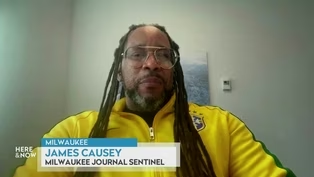
NewJames Causey on the Legacy of Giannis Antetokounmpo
Video has Closed Captions
Clip: S2400 Ep2450 | 5m 33s | James Causey on the impact of Giannis Antetokounmpo leaving the Milwaukee Bucks. (5m 33s)
 New
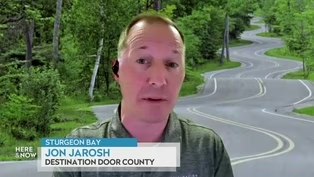
NewJon Jarosh on How Reduced Temporary Visas Affects Tourism
Video has Closed Captions
Clip: S2400 Ep2450 | 6m 23s | Jon Jarosh on what it means for seasonal employers to have fewer temporary visa workers. (6m 23s)
 New
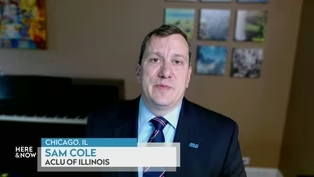
NewSam Cole on The Detention and Release of Salah Sarsour
Video has Closed Captions
Clip: S2400 Ep2450 | 7m 6s | Sam Cole on ICE's arrest of Salah Sarsour despite carrying a green card and his recent release. (7m 6s)
Providing Support for PBS.org
Learn Moreabout PBS online sponsorship New Episode
- News and Public Affairs

Top journalists deliver compelling original analysis of the hour's headlines.
 New Episode
- News and Public Affairs

Today's top journalists discuss Washington's current political events and public affairs.
 New Episode
 New Episode
 New Episode
 New Episode
 New Episode

 New Episode
 New Episode
 New Episode
 New Episode
Support for PBS provided by:
Here and Now is a local public television program presented by PBS Wisconsin