Oregon Art Beat
2026 Newbery Medal Winner Renée Watson: Inspiring young Black readers to step into their power.
Clip: Season 27 Episode 5 | 7m 44sVideo has Closed Captions
Portland Newbery Medalist Renée Watson inspires girls to be their best and boldest selves.
Winner of the nation's top prize in children’s literature, 2026 Newbery Medalist Renée Watson writes books that uplift and empower young Black readers. Find out what questions she asks her characters before she starts writing.
Problems playing video? | Closed Captioning Feedback
Problems playing video? | Closed Captioning Feedback
Oregon Art Beat is a local public television program presented by OPB
Oregon Art Beat
2026 Newbery Medal Winner Renée Watson: Inspiring young Black readers to step into their power.
Clip: Season 27 Episode 5 | 7m 44sVideo has Closed Captions
Winner of the nation's top prize in children’s literature, 2026 Newbery Medalist Renée Watson writes books that uplift and empower young Black readers. Find out what questions she asks her characters before she starts writing.
Problems playing video? | Closed Captioning Feedback
How to Watch Oregon Art Beat
Oregon Art Beat is available to stream on pbs.org and the free PBS App, available on iPhone, Apple TV, Android TV, Android smartphones, Amazon Fire TV, Amazon Fire Tablet, Roku, Samsung Smart TV, and Vizio.
Providing Support for PBS.org
Learn Moreabout PBS online sponsorship- I have a voice.
- [Class] I have a voice.
- My voice is powerful.
- [Class] My voice is powerful.
- My voice can change the world.
- [Class] My voice can change the world.
- [Renée] Go change the world, young people.
- [Photographer] Two, three.
- The first thought that came into my mind when I saw Renée Watson was author, Black excellence, amazing.
- It is such an honor to write for young people especially.
Reading is an intimate thing, and they're spending quite a bit of time with me when they're reading my books.
And so it means the world to me that adults trust me to come into their homes, really, and to whisper into their child's ear a story.
(music) When I was a child going into the library, I remember always wanting the sticker books because those felt like the special books.
I didn't really even understand that those were awards.
To have books out in the world that have those stickers is an honor.
Portland raised me, and now I live in New York City and in Portland.
I was in the second grade at this school in Ms.
Tupper's class.
I wrote a 21-page story at home, and I brought it to school, and Ms.
Tupper was like, "Wow, I think you're gonna be a writer one day."
- What were some struggles from being a Black woman when you were writing the book?
- So, some of the struggles that I've had is to balance our stories with joy.
This is from the book "Black Girl, You Are Atlas": I'm from that side of town where the media only comes for bloodshed, blood wasted, never for blood restored, celebrated, or regenerated.
I'm from hopscotch and double Dutch, from hide-and-go-seek and Pac-Man.
You'll notice with most of my covers that there's a dark-skinned Black girl on them.
And so sometimes I have to also fight for that.
I used to be told way, way back that books with dark-skinned girls and natural hair don't sell.
And so I'm so thankful that things have gotten a lot better in the industry, and so now I don't have to fight as hard.
How you doing?
- I'm good.
- Thanks for being here today.
- Thank you.
- What do you like to do?
- I do track, and I like to draw too.
- Nice, an athlete and an artist.
I love it.
- Renée stands out as a writer because of her incredible compassion.
- I used to think I wasn't pretty.
She taught me how, like, we are beautiful, and we need to, like, stand up for ourselves.
- One more.
- We will be meeting each other again one day, I am sure.
- The advice that I took was, "Just be you.
Be comfortable in your skin.
If you fall, get back up."
- I'm inspired by my family, my community, the young people that I have taught, and I want them to feel seen in my work.
- [Student] "A Black girl gives thanks for the aunties by blood and by choice, who knew how to give warning by look or clearing throat or sitting forward just enough to get the point across" - "I love, love our bounce back, our clap back, our backbone, our backstory, our comeback.
We go way back.
Our history dripping and damp from ocean waves.
I mean, I love our resistance.
Love our resilience.
I mean, I love us, loving us."
(music) My family was economically poor.
We were wealthy in many other ways.
We had a lot of love.
We just didn't have a lot of money.
If it was a friend's birthday and I wanted to get them a gift, I couldn't afford to do that.
So I used to write people poems.
People would come back to me and say, "Oh, Renée, your words moved me.
I read that poem and I cried," and I was like, "What?"
And that's when I started to feel like the power of words are naturally given to me, and I want to use that to make a difference in the world.
My first early works were not published until I was in my thirties, first written as short stories in high school.
(laughing) - Oh goodness.
- It is true.
It is really good to see you.
Which way are we gonna go?
- I know.
She was able to raise the consciousness of other students in the classroom through her writing, and Renée always carried that kind of wisdom with her.
- You were teaching us the work of looking out at the world, critiquing it, but also celebrating it.
(music) I don't think I would survive without my art.
Even at an early age, art was the thing that saved me.
Writing for me has been how I process what's happening in the world.
Anytime I'm around books, I am inspired to write.
My writing ritual is to ask my character questions: Who do you love?
Who loves you back?
What do you want?
What is in the way of what you want?
When is the last time you cried?
And what gives you belly-aching laughter?
When I know those answers, I have a little plot.
I love those moments when characters surprise me, when they make me push past my own stereotypes, my own assumptions.
But I need to laugh; I need to cry as I'm writing it if I want my reader to be feeling anything.
When I was writing "Piecing Me Together," I was struggling a bit with what is Jade's big question.
She feels safe and nurtured when she's in her community, and it's not until she goes out into the world where she starts to feel broken.
I really identify with Jade.
I think I cried through that whole chapter of just realizing that especially girls have that tug of war of being seen and unseen, being whole and broken 'cause of our bodies.
All the beauty issues.
- [Student] "Something happens when people tell me I have a pretty face, ignoring me from the neck down."
- I love Portland.
But there were times when Portland broke my heart.
I am Black, and I'm in a class of all white students, so how can I not stand out?
I am big.
How can I not stand out when I'm with a bunch of thin people?
So in some ways I was hyper-visible, and then I was invisible because they didn't want to hear the girl from Northeast Portland speak.
Sometimes the world we live in is not the world we want, but when I'm writing, I can right wrongs; I can change the ending.
I feel very powerful as a writer to push us to dream and to be better and bigger than what we are.
- Be bold.
- Be brave.
- Be beautiful.
- Be brilliant.
- [Together] Be your best.
(no audio)
 New
NewVideo has Closed Captions
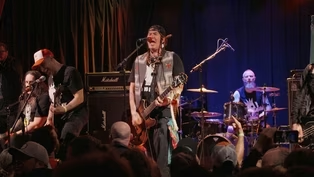
Clip: S27 Ep5 | 9m 19s | The Indigenous punk band 1876 rocks Portland and beyond. (9m 19s)
Providing Support for PBS.org
Learn Moreabout PBS online sponsorship














Support for PBS provided by:
Oregon Art Beat is a local public television program presented by OPB