Oregon Art Beat
1876 gives punk-rock and Indigenous communities a taste of something unique, while welcoming everyone to their mosh pits
Clip: Season 27 Episode 5 | 9m 19sVideo has Closed Captions
The Indigenous punk band 1876 rocks Portland and beyond.
1876, an Indigenous punk rock band based in Portland, Oregon, gives audiences a place to rock out as their true NDN (Indigenous) selves. Representing both the Northern Cheyenne and the Blackfeet nations, they make a point to sing in their traditional languages as well as include powwow drums on stage.
Problems playing video? | Closed Captioning Feedback
Problems playing video? | Closed Captioning Feedback
Oregon Art Beat is a local public television program presented by OPB
Oregon Art Beat
1876 gives punk-rock and Indigenous communities a taste of something unique, while welcoming everyone to their mosh pits
Clip: Season 27 Episode 5 | 9m 19sVideo has Closed Captions
1876, an Indigenous punk rock band based in Portland, Oregon, gives audiences a place to rock out as their true NDN (Indigenous) selves. Representing both the Northern Cheyenne and the Blackfeet nations, they make a point to sing in their traditional languages as well as include powwow drums on stage.
Problems playing video? | Closed Captioning Feedback
How to Watch Oregon Art Beat
Oregon Art Beat is available to stream on pbs.org and the free PBS App, available on iPhone, Apple TV, Android TV, Android smartphones, Amazon Fire TV, Amazon Fire Tablet, Roku, Samsung Smart TV, and Vizio.
Providing Support for PBS.org
Learn Moreabout PBS online sponsorship(rhythmic music) - My music is intentionally made to help people identify themselves somewhere because I didn't have that identity growing up.
I never really saw mixed NDN's on TV.
Everyone wants a history book NDN.
They don't want what's looking them in the face.
- [Audio Engineer] Yeah, can we get a snare?
(guitar thrumming) Go ahead.
- One of the presidents said that the Indians in America are the thorn in the side of American government.
Yeah, (chuckles) we are.
(guitar thrumming) The thorns on a rose stem protect the beauty of the rose.
That's what we are.
This is our culture.
This is our beauty.
- My name is Gabe.
I am also aka'd as Mr.
Steal Your Girl Some Horses.
I play in the band 1876.
I'm the creator of the band.
And I'm Northern Cheyenne on my dad's side, Blackfeet on my mom's side.
On our powwow drum, we have Joe.
He's my brother.
He's Northern Cheyenne and Blackfeet.
And then we have Danny, who's Comanche.
(drum resonating) On guitar, we have Chris Del Rio.
He's from LA.
He's a lot of energy on stage.
Our drummer is Luke.
He works for the Puyallup Tribe.
He teaches at their school, so he's very familiar with like, NDN culture.
By the way, NDN is short for Indigenous.
If people get upset, like it's NDN.
Indigenous.
Jake is our bassist.
He's not NDN at all.
(chuckles) We have a running joke that he's a blue man, like from the Blue Man group, that we picked up and washed off.
(laughs) I would never say this to his face, but he's like, one of the best things that's happened to this band.
- Check, check.
My name is Jake.
I got money in the bank.
Kind of.
I had money in the bank, but it went away on account of everything costing a million dollars now.
Check, check, check, check, check.
- [Audio Engineer] How does everybody feel up here?
- [Gabe] I'm good.
- Yeah, good?
- This photo, this is my dad's grandma, Emma Roland, on the Cheyenne side.
I have all these photos of my family, chiefs from my tribes and things like that.
Sometimes when I get stuck, I'll just look at those photos and literally say out loud, "All right, what do we want to say?
What do you guys want me to say?"
(guitar and drum kit resonating) - Eight count, right for this one?
- Yeah.
(music) - So 1876, everything I wanted it to be was about unification, because no one is leaving here.
Like, Indian people aren't going to go.
But we're the only people in this country who can say that we didn't run from our home.
I want to help teach about my people, help teach about who came here before everybody else was here, but it's not in a way to like wag a finger, it's more like, if you know the truth and I know the truth, let's move forward.
Like you know everything that I know now.
- All right.
Sounds like a punk set.
- [Jake] We got a lot of loading to do.
- [Jessie] How long are you guys on tour for?
- Two weeks.
- Two weeks, yeah.
Just two.
- It's 14 days, 14 shows.
- Ridiculous.
- As far back as you can get it.
- I closed it, didn't I?
- I do work in EMS, that came from going to Standing Rock.
There was a lot of chaos that weekend that I was there.
People were getting shot with water cannons and it was like freezing, and then they were getting pelted with bullets while they were trying to run away.
And I remember just thinking like, "I can't help anybody.
Like there's nothing I can, I don't offer anything here."
And so I never wanted to feel like that again.
And everything in my life brought me to like wanting to help whenever, however I can.
And then the music is a part of that.
My mom put roses on all of our cradleboards.
And so I'm beading a rose to put on my baby's cradleboard now.
Everything that punk rock is supposed to be about is what we are.
We tell the truth in our music when we speak, that's punk.
Everything punk rock tells you about your fashion sense and all that stuff is about self-expression and DIY.
We do everything ourselves.
The leather that I use right now, I tanned.
My dad, my brother and I, we made this drum.
Punk rock is just in my blood.
So 1876, the band name, it comes from the Battle of Greasy Grass, which is also known as the Battle of Little Bighorn.
That's when the Sioux, the Northern Cheyenne, Arapahos, Blackfeet people, Oglalas, Hunkpapas, we fought the Seventh Calvary.
(doors bang) Custer himself said, "There are not enough Indians in the world to stop the Seventh Calvary."
That's his exact words.
And we did.
And we did it through unification.
That's why I named this band 1876, because it's a message to NDN country.
We have to stick together.
We have to put our differences aside.
We have to have a common goal.
Yeah, yeah.
Well, they're going to get unfolded.
Should we just... Dude, we don't have enough time.
- We don't.
- All right, let's do it, let's do it.
Here, Danny.
We got a half hour until doors, so we got to bust these all out.
Boom.
Let's take one side and you fold it until you see the ink.
Once you see the ink, stop.
Fold the other side, stop.
So like, as NDN people, this is our home, and we are the only people who can say that.
When you're home, you not only deserve, but should be everywhere in your home.
If you're a city NDN who wants to go to the rez, go.
If you're a rez NDN who wants to move to the city, go.
We belong in every corner of this country, everywhere we should be.
One, eight!
- [Audience] Seven, six!
- [Gabe] One, eight!
- [Audience] Seven, six!
- One, eight!
- [Audience] Seven, six!
- You should know that this month, November, is Native American Heritage Month.
We as NDN people, we are always spoken over and we're not taught about, and when we try and teach people, they don't want to listen to us.
And if you're an Indigenous person, no matter where you're from on this country, the one thing that we need to teach you as NDN people is no matter what, never stop singing, never stop dancing when these (beep) try and stop you, dance on them, all right?
(music) ♪ Oh, tribes and tribulations ♪ ♪ Oh, tribes and tribulations ♪ ♪ Existence ♪ - Working in EMS, working in healthcare in general, like, you see a lot.
You smell a lot.
And one of the things that I've seen that probably not a lot of people have seen is like, the fear in someone's eyes when they're dying.
Like when someone knows, this is it, I've seen that, that look in their eyes, that fear.
And when I play shows, I like to scan the room and make eye contact with people because that's life.
And our powwow drum is the heartbeat of our people.
That's what it's meant to be.
And now I'm looking in your eyes and I'm seeing life.
♪ Existence ♪ ♪ Resistance ♪ ♪ Resilient, we stand ♪ ♪ Oh, tribes and tribulations ♪ ♪ Tribes and tribulations ♪ - Thank you so much, Portland.
Before we get out of here, we're going to sing it all together, all right?
On the count of four, we're all coming in together.
One, two, one, two, one, two, three.
♪ Oh, tribes and tribulations ♪ ♪ Oh, tribes and tribulations ♪ ♪ Existence ♪ ♪ Resistance ♪ ♪ Resilient ♪ (audience cheering)
 New
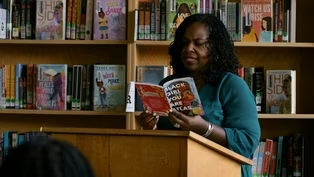
New2026 Newbery Medal Winner Renée Watson: Inspiring young Black readers to step into their power.
Video has Closed Captions
Clip: S27 Ep5 | 7m 44s | Portland Newbery Medalist Renée Watson inspires girls to be their best and boldest selves. (7m 44s)
Providing Support for PBS.org
Learn Moreabout PBS online sponsorship














Support for PBS provided by:
Oregon Art Beat is a local public television program presented by OPB