Garden Party
Spring is Sprung
3/10/2026 | 26m 47sVideo has Closed Captions
Trace Barnett attacks spring gardening do’s and don’t’s, from soil amendment to seed starting.
Trace Barnett attacks spring gardening do’s and don’t’s, from soil amendment to seed starting, before celebrating the season with a traditional Appalachian recipe.
Problems playing video? | Closed Captioning Feedback
Problems playing video? | Closed Captioning Feedback
Garden Party is a local public television program presented by APT
Garden Party
Spring is Sprung
3/10/2026 | 26m 47sVideo has Closed Captions
Trace Barnett attacks spring gardening do’s and don’t’s, from soil amendment to seed starting, before celebrating the season with a traditional Appalachian recipe.
Problems playing video? | Closed Captioning Feedback
How to Watch Garden Party
Garden Party is available to stream on pbs.org and the free PBS App, available on iPhone, Apple TV, Android TV, Android smartphones, Amazon Fire TV, Amazon Fire Tablet, Roku, Samsung Smart TV, and Vizio.
Providing Support for PBS.org
Learn Moreabout PBS online sponsorship- This is everything you need to know about "Garden Party."
We're in brilliant Alabama, and this is my homestead.
Come on, I got a lot to show ya.
Come on, Murph!
(playful music) Welcome to my kitchen garden and chicken yard.
As you can see it's bathtime right now, chicken style.
(chickens clucking) Welcome to my greenhouse.
This is where all my annuals live in the dead of winter.
We move 'em all out into the gardens, and it becomes a real jungle out here.
Speaking of jungle, check out Cecil.
He's really the king of the yard.
He's enjoying some dinner right now, looks like.
Not dinner time for us.
I got more to show ya.
Come on, follow me.
This is my pollinator garden.
In the heat of summer, it really comes alive.
There's more to see inside, come on.
Lots more.
(door squeaking and thudding) Right this way.
(voice pitching) Welcome to my kitchen.
Everybody thinks it's a set, but this is actually my real deal kitchen, filled with real deal junk.
(pan clanking) I change my decor about as much as I change my hair, which is pretty often.
Follow me down the alley, and I'll meet you around the corner.
(air whooshing) This is the dining room.
Meet me over in the bird room where all the noisiest friends in this house live.
Get your earplugs ready.
(birds chirping) This is Ruby, and this is the really loud ones that really like to chirp right when we get into a project.
Ruby's real shy, so she's headed back into her nest up in the wall, scaling the curtains like Mount Everest.
(lively music) I'm Trace Barnett, and welcome to "Garden Party," a show where we dive into my favorite family recipes, garden tips and tricks, and Alabama specialties, all with a swanky southern twist.
(swanky music) (bubbles popping) Spring has sprung, and we're out in the garden getting ready for a bountiful season of flowers, vegetables, and herbs, which means it's time to amend and prepare your soil, start your seeds, and we'll round out the day with a special Appalachian recipe that I look forward to every spring when the green starts sprouting.
So the key to any successful garden really starts with the soil, and I'm gonna show you my favorite tips and tricks to really give those tiny seedlings the best chance to thrive.
So to get started, we are going to want to pull any loose debris, that could be leaves, sticks, weeds, old roots, or old plants, anything that has gathered in our garden bed throughout the garden season.
Now these rules apply whether you are gardening in a raised bed or a direct sow garden.
So just follow along.
So remove all of those leaves.
Now, some organic matter is good on our garden soil, but if it's heavy leaves, heavy sticks, that's gonna hinder our vegetables from growing.
Now's the time also to pull any kind of weeds or grasses that may have come up during the winter months as well.
Removing any weeds or large leaves or large debris allows our seedlings to have ample room for sufficient growth.
So one of my big tips if you're working in your garden bed or your garden area is to simply have a couple bricks or flagstones on hand.
That way when we're working our dirt, we're also not smushing it back down as we're working.
You want to loosen the dirt up to 6 to 12 inches below the surface.
That's gonna really open up the dirt, make it really soft, and easy for those deep rooters such as tomatoes, potatoes, peppers, anything of that nature to dive deep down into the ground and reach those nutrients.
Now is the time to dig out your handy dandy pitchfork, and if you don't happen to have one of those on hand, just ask your mother-in-law.
(crickets chirping) So take your pitchfork, and with a good bit of pressure, put that right into the dirt there, and just start working it around in a circle motion.
With a great deal of force, take that pitchfork and just drive it into the ground and pull that dirt up.
(engine roaring) As you can see, as I'm working the soil, it's pulling up smaller weeds, old roots from vegetables, which is then aiding in the process of cleaning our bed too.
You'll wanna pick out any small grasses that you see lingering around because we don't want them to be competition for our flowers or vegetables later.
If you have chickens, now's the perfect time.
Let your chickens loose, and let 'em run around in this bed, scratch, and eat all of those bad organisms that are in there.
Now, when it comes to fertilizers, I usually stick to the basics: compost.
Compost is full of those vital nutrients that all plants need to survive and really thrive through the summer months.
So I'm gonna add our compost directly onto our garden bed here.
You're going to want roughly three to four inches of compost on top of that already loose soil.
(compost raining) Now this is black gold, and this is one of my favorite fertilizers to add, and that is worm castings.
I'm sure you're thinking, "Ew, worm poop.
What can that do for my vegetables?"
And I can tell you it will do everything.
You can buy worm castings online or at your local home improvement store, and I would suggest that you need one pound of worm castings per foot of garden.
Throw that directly on there.
And there's a worm right there in our worm castings.
Since vegetables crave phosphorus, potassium, and nitrogen, I'm also gonna add in a little bit of bone meal to our soil.
And if you're a chicken keeper, I suggest you add some broken eggshells; they're probably already in your compost, but they just add that last little touch of goodness that we need to our garden bed.
So once again, grab your pitchfork, and let's start working this into our soil.
(clock ticking) (sighs) Oh my gosh.
Gardening's a lot of good, hard work and exercise after being inside and eating all those sweets all winter.
Make sure that your garden bed or gardening area is completely smooth.
You don't want any lumps, ridges, or dips because that's gonna cause water to run off, collect, and stand in places that you don't want it to.
(bubbles popping) I learned how to amend soil really when I first started gardening 'cause soil really is the foundation.
There was that part of a generation that used fertilizers like Triple 13, all of these completely inorganic fertilizers which then impart themselves into our plants.
So I really wanted to get back to the basics of gardening, which is really what the plants need.
They need composted material, they need a bit of manure, they need a little bit of poop every now and then, and they need good sunlight and good water.
If you don't have the right soil, then you can't grow anything.
(lively music) Guess what?
You have the best foundation to get your gardening started, and you're ahead of everybody in the game because in Alabama we can garden all winter long.
(bubbles popping) Our soil's prepped, and now it's time to start our seeds.
I'm gonna meet you in the big greenhouse, and we'll get 'em started.
Let's talk dirt.
I prefer to use a good, high-quality potting mix, and you can really tell the quality of a potting mix by simply putting the dirt in your hand and balling it up just like that.
And when you pull it open and you see like these small balls, that means that this dirt is retaining enough moisture, perfect for starting seeds inside.
So to our dirt, I am going to add just a little bit of water.
You don't want your mixture to be completely saturated.
You kind of just want it to be just ever slightly moist.
So you want a dirt consistency about like that, not mud.
Of course, you can also use something to stir this with, but I prefer to use my hands.
(mud squirting) I love to reuse these little six-plant cells that I just get every year.
Annuals come in these, tomato plants come in these.
I hang onto them rather than throwing them in the landfill because they are the perfect vessel to grow your seeds in.
I'm gonna use my scoop here, and I'm just gonna start throwing dirt into those cells.
(lively music) So fill those up just like so.
I'm ditching that.
(object thudding) You don't want to overfill these because you don't want any dirt running over as you water them, because that might cause our seeds to waterfall effect over into our tray.
You also don't want to take your hands and just press hard onto these because you want that soil to have air in it because that allows our fresh roots to grow deep down into the dirt.
So what I like to do is take our cells and just lightly tamp it just like that.
(bubbles popping) And now comes the important part.
Let's start planting some seeds.
The most important step of this whole process is to look at your seed packet.
Every bit of information that you need to know about your seed is on the back of this packet.
I also suggest after you plant your seeds, you take your packet with a Sharpie and just write on there the date that you planted your seeds.
Now, depending on the size of your seed, I have a couple little tools here in my arsenal.
One is just a toothpick, (bell ringing) and the other is just a pair of tweezers.
Simply take your toothpick here, and I'm gonna make a small hole in the dirt.
So I'm going a fourth of an inch with my handy dandy toothpick.
Then you can use it for your teeth later.
(chiming music) With my tweezers, it's easier to do this with tweezers unless you have small child hands or if you have a small child on hand who would love to help you plant seeds.
If not, the tweezers work perfectly.
Take that and drop that directly in to each of those pre-made holes.
Some seeds, depending on the variety, require soaking or nicking.
So soaking your seeds basically means if it has a hard exoskeleton... I don't think it would be called an exoskeleton if it's a seed, would it?
(signal beeping) Some seeds that have a hard outer shell, almost like an exoskeleton, sometimes those seeds need to be soaked.
So drop those directly into a little glass of water.
I prefer to use a clear glass because that way I can see what is happening in there.
I would soak this for about 24 hours prior, changing the water occasionally if it does start to turn cloudy.
If the outer shell is super hard, use just a little pair of fingernail clippers and barely clip the outside of that shell, and that's gonna speed up germination.
So once we have our seeds placed perfectly into our seed cells here, I'm just gonna take my hand and just lightly cover each one of those eggplant seeds.
You don't want to cover those and smush them down into the soil because we don't want to hinder the growing process.
I love to use one of these misters that I just simply grab at a home improvement store and simply just give those a nice even mist.
So now that we have our seeds watered, let's talk about creating a mini greenhouse over our seeds.
I prefer to use simple plastic that I just lay directly over my plants there.
I like to just take those same toothpicks, and we're just gonna stick those in each corner to hold that down.
We don't want this blowing off and all of our beautiful seedlings in there just gasping or dying.
(church bell ringing) You will want to remove this plastic as needed to water and just fold it half back like that.
Water your seeds sufficiently, fold that back over, and simply attach once again.
This is gonna create a greenhouse effect, and it's really gonna lock in all of that good moisture as our dirt heats up, and it's gonna germinate our seeds perfectly.
(bubbles popping) (teeth chomping) I learned to start seeds at a young age because I come from a real cheap family, and we also wanted to grow a lot of vegetables.
(chicken crowing) So I learned how to start seeds from really a combination of my grandparents on both sides because they both grew different things in their garden, and it just was so much more economical to grow large scale starting with seeds.
And I think that's really the answer to gardening is gardening shouldn't be expensive.
It shouldn't have all of this laborious equipment or anything.
It should just be readily accessible to anyone.
And starting seeds by hand (chicken crowing) is just kind of the quintessential way to start a garden.
It is life itself.
(bubbles popping) Now that we have our seeds covered in plastic, now's the time to move those to an area where you can get six to eight hours of sunlight on these daily.
We are gonna let these just marinate under this plastic until roughly 50% of our seeds are up.
So we planted 36 eggplants here.
You roughly want 18 eggplants up, and you don't want them up more so than about just peeping up above the surface.
I mean just barely a fourth of an inch.
Now's the time we talk grow lights.
I've got some down here started for us.
So I'm gonna move these out.
(chickens clucking) There are tons of grow lights out there on the market, and they are very economical.
So I'm going to plug this in here.
(electricity hissing) And you want to affix your grow light to where it is always three inches above your plant shoots here.
So as your plants grow from small seedlings into developing their long-lived leaves, you are going to want to raise this grow light so it's continuously three inches above your leaves.
You are gonna want to leave these under your grow light until temperatures outside are warm enough to where you can start hardening these plants off.
And you're probably wondering, what does hardening off mean?
So any plant that you start or grow indoors is gonna require some time outside before it can fully acclimate.
I would suggest taking your plants out onto a porch and start with a minimum of two hours.
Don't put them in the direct sun or in the direct wind.
Put them somewhere protected just where they can ease their way into the world.
You're gonna wanna bring these back in at night and the following day for the next 12 days, which sounds a little arduous, I know, but they are our babies, and they need our utmost of care.
For the next 12 days, you're going to want to extend your time out in the elements by an hour or two.
So after your 12 days of acclimating your seedlings to the big, bad world is over, it's then time to plant those in our growing beds and dream about that abundant harvest that's, you know, just a short turn around the corner.
(bubbles popping) The greens are growing, and it's time for me to show you one of my favorite springtime recipes: goose feed.
It's real Appalachian, y'all.
Meet me in the kitchen; I'll show you how to whip it up.
You're probably wondering where the name goose feed came from, and I'm sure that's hidden in the tales of Appalachia.
My mom lives 25 minutes away, and they grew up calling it rabbit feed.
So I guess they had more rabbits running around than geese.
But the name actually comes from spring greens just perfectly coming up out of your garden bed and into your yard.
Those tender greens are the perfect food for geese, rabbits, chickens, and people alike.
So today I'm using mustard greens, fresh spinach, and fresh romaine lettuce right out of the garden.
I'm gonna use a sharp knife here.
And what I want to do is I really just want to almost shred that lettuce.
We're gonna use the lettuce as the base for our goose feed and pile all of our other greens directly on top.
(knife chopping) Throw that directly onto a large platter.
We want this to just be like spring's bounty jumping at us (majestic music) as we assemble our goose feed here.
Next, I want to add our mustard greens.
So if you're using any kind of green like kale, mustard green, dandelion green, be sure and wash those thoroughly.
These spring greens usually have a lot of residual dirt or grit that can get locked into them.
So do it like my mama always did it.
Get your big dish pan out and just drown those greens (water splashing) in water multiple times.
So to work with our greens here, I'm gonna pull this away from the stem because we don't want the stem there, and then I'm simply going to rip it over our salad there.
A lot of times with mustard greens and kales and other greens, it's easier to rip them rather than cut them because if you cut them, what it's gonna do is it's gonna smush them in a way.
And we don't want a soggy green on our goose feed.
So now that we've layered our mustard greens onto our fresh romaine lettuce, I'm gonna throw in some spinach.
Another good option for this would be arugula if you've got that coming up in your garden as well.
I love the colors of this as they come through.
It looks like spring on a platter.
You roughly need about two pounds of greens for this recipe.
And of course, that's gonna vary depending on the size of your crowd.
But I will say that you need to have more greens than you think you're probably going to need because they do wilt up a bit when we pour our bacon jam on top.
Now that we've got our spinach layered on top of our goose feed here, I'm going to sprinkle some green onions directly on top.
Now you can't make goose feed without having green onions and radishes.
So just loosely chop your radishes.
I'm gonna remove the top and the bottom of that.
Cut it in half.
I'm gonna cut that in half again, and then I'm just gonna run my knife directly through that.
Just a simple chop.
I love radishes, so the more the merrier.
I'm also gonna use a few radishes here just for a little bit of garnish 'cause, you know, we like to make things pretty.
Add those just to the side there.
Now here comes the most important component of our goose feed.
So traditionally in old Appalachian recipes, they would pour hot bacon grease and bacon drippings directly over the goose feed, almost like a wilted salad of sorts.
But I'm gonna upgrade ours just a tad by using bacon jam.
(bubbles popping) Most of the recipes from "Garden Party" are old family staples (chicken crowing) that have like an updated twist.
And that updated twist could be something where it's budget-friendly, or it has a new flavor technique, or even a spice that maybe they didn't have 200 years ago.
Goose feed is something that I have been eating since I was a child.
Like, I remember going out with both of my grandmothers; one called it rabbit food, one called it goose feed.
We would go out into the garden, gather all the spring greens even into the yard, (chicken crowing) and gather dandelion greens, anything wild even, and combine it into this delicious salad that was wilted with bacon grease.
But I'm thinking what's more flavorful than bacon grease?
Bacon jam.
(bubbles popping) You're going to need (teeth chomping) roughly a pound or a pound and a half of good quality, thick-cut bacon.
You want thick-cut bacon because we don't want our bacon to disappear into our jam.
So I am slicing our bacon up here into chunks.
I've actually found that it's easiest to slice bacon up by just leaving it in the slab that it comes in.
You want to rough chop this bacon and leave it in larger chunks because we want to have that little bit of bacon bite when we have our bacon jam on top of our goose feed.
Once you have your bacon nice and chopped, add that to a large skillet.
Always start your bacon out in a cool skillet too because it helps crisp it up.
I have went ahead and chopped a whole onion, roughly just about a cup of onion, just small, finely chopped.
And I'm gonna add that to our bacon as well.
Now let's transfer our bacon and onions to our stovetop over medium-high heat.
(playful music) (bacon sizzling) So while our bacon and onions are cooking away over medium-high heat and getting all nice and golden and crispy, I'm going to combine one and a half cups of dark brown sugar.
This is gonna form that really good, sticky, ooey-gooey sauce that one thinks of when they think of bacon jam.
I'm also gonna add a cup of sorghum molasses, and sorghum molasses has that really good smoky flavor.
Super southern too.
I always have to get a little taste of it.
Give that a good stir.
Now to deglaze our pan, I'm going to add a couple tablespoons of red wine vinegar.
You can also use balsamic, and if you imbibe, you can also use a little bit of bourbon 'cause it's just gonna cook off.
But what we want are those nice bacon drippings to release into our bacon jam.
Just give that a good aggressive stir to get all of that loosened up off the bottom of the pan.
I'm gonna go ahead and add our mixture here, and you don't have to worry about mixing this too much.
You kind of just want the sorghum to kind of combine somewhat with the brown sugar.
Stir that really well.
Keep your sorghum on hand also because you may need just a tiny bit more, actually always a little bit more.
You can't have too much sorghum.
So I'm gonna put just a tiny bit in there.
(magical music) Give that a good stir.
After we've added our last bit of sorghum into our pot here, we're gonna cook that over a medium heat for 8 to 12 minutes just until all of that brown sugar dissolves, the bubbles start to form, and all of that sorghum turns into a nice syrup for our jam.
I'm gonna add just a pinch or two of black pepper, and we're ready to plate it up.
(bubbles popping) So while our bacon jam is still nice and hot to wilt those greens, let's plate this up.
I'm gonna plate it the old-fashioned way.
So I'm gonna take a little bit of corn pone here, just some fried cornbread.
I'm gonna take a little bit of this goose feed, actually a lot of this goose feed.
And I'm gonna pile that just right on top of that corn pone.
I'm gonna be stingy and get all the radishes and green onion too.
So sorry for whoever else is eating this.
And then this is the best part.
Take that hot bacon jam and just put it right over those greens and that corn pone.
I'm gonna get a little of that juice there.
Drizzle that amply over your greens.
And what that's gonna do is it's just slightly wilt the greens, just so.
You can serve this as a salad side.
You can serve it as a starter, you can add a protein and have it as a main meal.
And I promise it's not gonna turn you into a goose, hasn't me anyway.
Now's the best part.
This might make me quack a little or whatever geese do, honk.
(goose honks) The bigger the bite, the bigger the flavor.
Hmm.
Spring greens with bacon jam, goose feed, don't fly away now.
(lively music) Now you're ready to get your soil amended, seeds started, belly fed just in time for spring.
Thanks for joining us.
We'll see you next time on "Garden Party."
(lively music continues) Is that... It needed a little bit more enthusiasm.
I feel like I'm yelling.
Gonna quack?
She's gonna lay down, oh!
So I learned to amend soil.
You learned to amend soil.
(chicken clucking) There goes my prop.
(laughs) Hush up, dogs!
(dogs barking) We're trying to do some TV here!
How's my bangs look?
(laughs) Oh, my arms.
(laughs) Adequately, sufficiently wet?
(laughs) Don't know where to go.
Did y'all think y'all be sitting around watching somebody cut radishes quietly?
You can find all of our recipes, how-tos, helpful blogs, and a whole mess of fun over on our website.
Scan the QR code below or visit aptv.org/gardenparty.
(huffs)
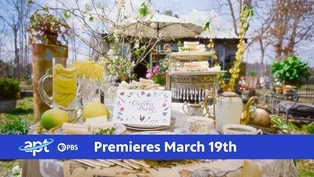
'Garden Party' season 4 airs at 8 p.m. CT on Thursdays with repeats on Saturdays at 1:30 p.m. (30s)
Providing Support for PBS.org
Learn Moreabout PBS online sponsorship

- Food
Christopher Kimball’s Milk Street Television
Transform home cooking with the editors of Christopher Kimball’s Milk Street Magazine.










Support for PBS provided by:
Garden Party is a local public television program presented by APT