
Lexington's Public Square
Clip: Season 31 Episode 14 | 6m 28sVideo has Closed Captions
Learn about Lexington's Public Square.
As the founders of Lexington left the Fort they initially established in order to lay out a city in the 1780s, they designed a Public Square at the center of the town on Main Street.
Problems playing video? | Closed Captioning Feedback
Problems playing video? | Closed Captioning Feedback
Kentucky Life is a local public television program presented by KET
You give every Kentuckian the opportunity to explore new ideas and new worlds through KET. Visit the Kentucky Life website.
Lexington's Public Square
Clip: Season 31 Episode 14 | 6m 28sVideo has Closed Captions
As the founders of Lexington left the Fort they initially established in order to lay out a city in the 1780s, they designed a Public Square at the center of the town on Main Street.
Problems playing video? | Closed Captioning Feedback
How to Watch Kentucky Life
Kentucky Life is available to stream on pbs.org and the free PBS App, available on iPhone, Apple TV, Android TV, Android smartphones, Amazon Fire TV, Amazon Fire Tablet, Roku, Samsung Smart TV, LG TV, and Vizio.
Providing Support for PBS.org
Learn Moreabout PBS online sponsorship[music playing] Every city has a central location where townspeople know they can come together, attend events, and find friends.
It's a place where memories are made and where history exists.
At its beginning, Lexington would form its own public square, a block of land in the center of town with a courthouse for citizens to conduct legal business and a place for an open-air market.
Lexingtonians now come together at Tandy Square and celebrate today along with the history of yesterday.
[music playing] Lexington, Kentucky, was established in 1775 by explorers who first gathered around McConnell Springs in the middle of Fincastle County, the western edge of what was then the colony of Virginia.
These pioneers built a large fort, naming it Fort Lexington, after the recently fought battle of the Revolutionary War.
In 1780, they were ready to leave the fort and build a city.
A map was drawn up, dividing the surrounding land into plots for the founders to build new homes.
In the middle of this map, on Main Street, was a plot called the Public Square.
Here, the city fathers planned for a courthouse on the east half of the plot, and the west half would become a marketplace for citizens to bring crafts and agricultural goods to trade and sell.
The first public building on this Public Square was not a courthouse, but rather a schoolhouse, which would lead to a story etched into the city's history.
One day, schoolteacher John McKinney was confronted by a wildcat.
McKinney would actually wrestle this wildcat, and eventually, he killed it.
As this frontier city grew, Lexington would become known as the Athens of the West, home to the arts and sciences of Transylvania University.
The marketplace would take on an appropriately refined name, Cheapside, a name originating from one of London, England's largest marketplaces.
While an initial courthouse was built on the Public Square, it was replaced shortly after in 1806 with a large courthouse worthy of the Athens of the West, three stories high with a tower and a clock.
Courthouse litigations would draw large crowds to Cheapside, and the term Court Day was adopted for the main sales day.
One aspect that would dominate this marketplace was Lexington being at the center of Kentucky, and Kentucky was a slave state.
In the early 1800s, in addition to the trading of agricultural products, Cheapside became the center for the selling of enslaved people.
Lexington was one of the largest markets for the enslaved in the Upper South, so Courthouse Square is a place where enslaved individuals were sold constantly.
Slave sales would finally be outlawed in 1864, and Cheapside would return to being the center for Court Days.
In 1883, Lexington would replace the courthouse that was now over 75 years old.
One feature was added inside the new courthouse that drew great attention, Woman Triumphant, a statue sculpted by Kentuckian, Joel Hart.
Just 14 years later, this courthouse would catch fire, destroying Woman Triumphant as the roof collapsed.
A new courthouse would be built on the same location the city's forefathers had designed more than a century before.
Its ornate and decorative stonework was designed and constructed by a former slave turned architect, Henry A. Tandy.
Tandy's work was recognized throughout the bluegrass for his attention to detail.
During World War I, this new courthouse, along with Cheapside, would serve as a formation point for soldiers going off to Europe.
Court Days would end in 1921, but Cheapside continued to be the center of the city.
Initially, as automobiles were filling the streets of Lexington, the area was used as a parking lot, but city leaders chose to redesign Cheapside with grass, trees, and walkways.
It would become known as Cheapside Park.
Once again, townspeople had a place to gather.
Along with the rest of the country, citizens there would honor the memory of President Franklin Roosevelt when he died in 1945.
This public square became a forum for crowds to gather and listen to politicians.
In 1973, the city would begin a new market tradition, farmer's market, that would eventually find its home in Cheapside Park.
Through the turn of the century, this park would draw citizens for different reasons, many political and historical.
In 2017, a group of Lexingtonians would form a movement, Take Back Cheapside, in an effort to reimagine the former slave market as a place of inclusion and healing.
In 2021, the name of Cheapside Park would change.
It became Tandy Park, named after Henry Tandy, the formerly enslaved entrepreneur who was instrumental in the construction of the courthouse.
A covered pavilion was built that today enhances outdoor events that bring people downtown.
On Saturday mornings, you'll find crowds buying fresh vegetables, fruits, and flowers at the farmer's market.
And on Thursday nights during the summer months, it's the home for music and the arts.
And all the while, Tandy Park connects the people of Lexington with the history of this public square.
Designed by the founders at the city's beginning, and now a place to gather together under the shadow of a courthouse with its beautiful stonework designed by a former slave.
[music playing]
 New
NewVideo has Closed Captions
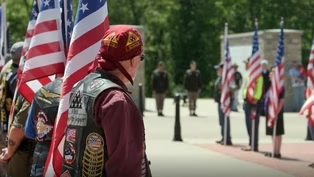
Clip: S31 Ep14 | 6m 51s | A Western Kentucky couple works to identify unclaimed remains of veterans. (6m 51s)
 New
NewVideo has Closed Captions
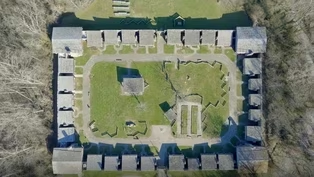
Clip: S31 Ep14 | 2m 53s | Chip visits Fort Boonesborough. (2m 53s)
 New
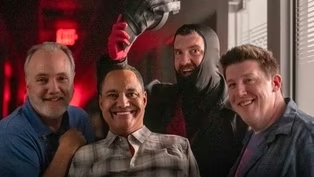
NewScary Good: The Heart Behind the Horror
Video has Closed Captions
Clip: S31 Ep14 | 7m 42s | These filmmakers share more than just a passion for jump scares. (7m 42s)
Providing Support for PBS.org
Learn Moreabout PBS online sponsorship












Support for PBS provided by:
Kentucky Life is a local public television program presented by KET
You give every Kentuckian the opportunity to explore new ideas and new worlds through KET. Visit the Kentucky Life website.