
Almanac Showcases a Collection of Retiring Lawmakers
Season 2026 Episode 42 | 56m 39sVideo has Closed Captions
Mary Lahammer features retiring lawmakers in their final session.
Mary Lahammer talks with Governor Walz after the end of the 2026 legislative session and reflects with retiring lawmakers as they bid farewell to the legislature.
Problems playing video? | Closed Captioning Feedback
Problems playing video? | Closed Captioning Feedback
Almanac is a local public television program presented by Twin Cities PBS
Almanac Showcases a Collection of Retiring Lawmakers
Season 2026 Episode 42 | 56m 39sVideo has Closed Captions
Mary Lahammer talks with Governor Walz after the end of the 2026 legislative session and reflects with retiring lawmakers as they bid farewell to the legislature.
Problems playing video? | Closed Captioning Feedback
Where to Watch Almanac
Almanac is available to stream on pbs.org and the PBS app.
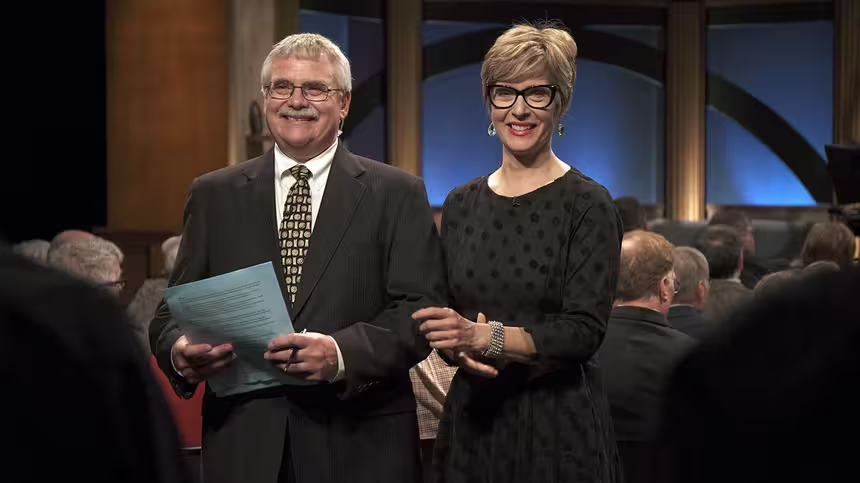
A Minnesota Institution
"Almanac" is a Minnesota institution that has occupied the 7:00 p.m. timeslot on Friday nights for more than 30 years. It is the longest-running primetime TV program ever in the region.Providing Support for PBS.org
Learn Moreabout PBS online sponsorship(bright music) - "Almanac" is a production of Twin Cities PBS for the stations of Minnesota Public Television Association.
- Change is coming to the capitol, a special edition of "Almanac," reflecting with some key retiring lawmakers that's coming up on "Almanac."
(gentle music) (gentle music continues) (gentle music continues) (gentle music continues) - "Almanac" is made possible by members of this public television station.
Support is also provided by Great River Energy, providing wholesale power to 1.7 million people through its member owner cooperatives and customers.
Delta Dental of Minnesota Foundation, improving oral health and helping communities thrive.
deltadentalmn.org/tpt Education Minnesota, the voice for professional educators and students throughout the state more at educationminnesota.org And Vanessa Dayton, through the Healthcare For All Minnesotans Fund, supporting accessible healthcare statewide.
(upbeat music) - Welcome to this special edition of "Almanac."
I'm Mary Lahammer at the capitol, which will look very different next year with a new governor and dozens of new lawmakers.
About a quarter of legislators are leaving their jobs and they have lots of wisdom to share.
We'll hear from some of them throughout the next hour.
But we begin with Governor Tim Waltz in his final legislative session.
Here's a selection of his observations.
Good session, right on.
Unexpectedly productive session.
Tied house, one vote margin in the Senate.
Are you surprised how much got done?
- No.
I think we have serious legislators, and I said for eight years, I think people forget on this for all but two of those years we've had divided government.
We found ways for eight years to get budgets done.
No shutdowns, we've got surpluses across the horizon and we've invested in Minnesota, so I really appreciate it.
It was challenging.
Been a tough year.
It's against the backdrop of, of course the murder of Melissa and Mark, and then- - We're staring at her memorial.
- Right here.
All session long.
The flowers, the memorial that hung over the whole session.
- Yeah, I think so.
And I think it forever changed this place, but I do think one of the things was the spirit of the legislators here.
We found a way.
It was very contentious, these issues, you know, and there's a lot of differences of opinions, especially the annunciation shooting added into that.
And then this winter with ICE.
And against that backdrop of the dysfunction in DC, the longest shutdown in American history in DC, we figured out a way together in this divided government to get some good things done.
- This is one of the biggest parts of your legacy this week.
You got to make two really important chief justice of the State Supreme Court and another appointment this lives on.
You have now appointed the vast majority, the state Supreme Court, and you've leaned in on diversity.
Talk about the importance of that.
- Yeah, and again, this isn't like a, you know, you're woke for woke.
It's important that people see themselves represented.
And as Minnesota becomes more diverse, lived experiences, lived life experiences impact justice being served.
And I think the reason you don't hear a lot of grousing about this is 'cause Minnesota has a judicial selection committee that is Republicans and Democrats.
And most of these judges come through that process to me, and then I interview the finalists.
These are folks that you'll hear people say, look, they are just good.
I did not hire democratic judges.
- [Mary] And we heard qualified, that word came up qualified over and over, qualified.
- I hired people who cared about the rule of law and qualified.
You have the first time in Minnesota history, someone who served on a district court, court of appeals and the Supreme Court as well as a public defender.
- First public defender, that is historic.
- Yes.
And I think you have diversity in that.
We have people who are experts in corporate law.
We have folks- - And nonpartisan, this court didn't always rule in your favor, despite you appointing them.
- You didn't love everything they did, right?
- No, but I hope you saw in the one exception around some of these payment withholdings that came back up again this week.
But when they made these consequential decisions, it's the responsibility of us to say, look, I don't have to agree with it, but I respect it and we will honor it.
(gentle music) - Now to our conversations with lawmakers who are leaving, we begin with tough longtime tax committee chair whose public service has spanned more than 40 years.
This is DFL Senator Ann Rest.
Ann Rest knows this territory well.
For 14 years, she's been the state representative for suburban District 46 A.
- Hi.
- Hi.
- I'm Ann Rest, a state legislator and I'm just visiting in the neighborhood.
- Representative Rest acknowledges she did support the stadium question, but then changed her mind when the public overwhelmingly said no to tax dollars for a stadium.
- I didn't support any bill coming forward in the 1998 session.
My name is not on any legislation and no bill was given a hearing in the committee that I chair where that bill would have come.
- Rest chairs the local government in Metropolitan Affairs committee, and has held powerful posts in the legislature.
Now she finds herself running to save her seat and help retain democratic control of the House.
We're still waiting for the Senate tax bill, but Chair Ann Rest is tough.
And negotiations even with a fellow Democrat won't be easy.
- [Speaker] When you say a medical license fee of a million dollars, when those two came up, wasn't that a tax?
- The definition of a fee and a tax is very different.
What we're looking at here in our jurisdiction is the sales tax.
There's no wealth photography not in this committee.
Is that clear?
Is there an amendment to House file 28?
I will remind the members to address your comments to the president and not directly to other members.
Is there an amendment to House file 28?
- I would ask that you vote no on the A7 amendment.
- I will remind members, even those who usually stand in this place, that you need to direct your remarks to the president and not to the members.
House file 28 is laid on the table.
Senator Dziedzic.
- Thank you, Madam President.
I move to recess- - Once again, I'm gonna ask people to stay at their desks and to refrain from conversation.
Senator Dziedzic?
- Thank you Madam President, and I move to recess until the call of the president.
- Senator Dziedzic has moved that we recess till the call of the president.
- We asked about jury duty.
- Madam President?
- Go ahead Senator Latz or Senator Dibble.
Sorry.
- [Rest] Senator Pratt.
- [Senator] Madam President.
- Senator Pratt.
Senator Dibble.
Where are you standing Senator Pratt?
- [Senator] At my desk.
- You're not standing up here, are you?
- No.
Madam President.
- So you can't call on Senator Dibble.
Senator Dibble?
(upbeat music) - We just saw an action all the way back to her time in the House.
Senate Tax Chair presiding over the Senate.
The legendary, tough, smart and fair.
Right?
You call him out on both sides of the aisle.
Senator Ann Rest, retiring after more than 40 years in the legislature.
Wow.
Both sides.
This is fair.
Everybody who knows.
You say you don't pick favorites, do you?
- No.
- Why is that?
Where does that come from?
- Well, it it comes from a respect for the institution rather than playing favorites with individual members.
And that is a core value of mine in terms of public service, that is viewed by the public inside the chambers that we serve in, whether it's a Senate chamber or here in the House.
- Somebody recently said you're the only one who hears bills on both sides of the aisle anymore.
- Absolutely, those bills are coming on behalf of a constituency.
And we have to remove the R or the D after a bill.
And if it's worthy to be heard, um then on behalf of a constituency, then it shouldn't matter.
And we have very vigorous conversations in the Senate tax committee.
And they're always, um, They're always respectful, um Sometimes they are um very funny by the way.
- Yes, and we were laughing through all of that, right?
You do, when you wield a gavel, it is with a twinkle in your eye, is it not?
- I, um, you mentioned um Representative Torkelson talking about no shenanigans.
- [Mary] Yes.
- Well, I call people on that as well.
And what we end up doing is getting a laugh out of it.
And I think, um, that refocuses our, um, our discussions no matter how serious the topic.
- Did you know that you went viral with how you were presiding over the chamber?
Were you aware when that happened?
As they say - Yes.
- [Mary] And what did you think about that?
- My job was to, uh, keep decorum and to make sure that because I was standing up there, that no one was going to take advantage of the traditions of the Senate, because I would remind them otherwise.
- How about how nonpartisan you are when you are presiding over the chamber?
Because it's become an assumption, whether it's the House, whether it's the Senate, whether it's Democrats, Republicans, that who's ever presiding is going to rule in favor of their own party.
- I think that there is a, uh, there is a matter of trust that comes from, um, because you're in that position where for me as a president pro tem as opposed to senator champion, that, um, we have been entrusted by our caucuses to, um, understand the perspective that we bring our caucus brings.
And not to let it be abused by others.
And sometimes that might look like you're playing favorites, but it's really, uh, it's really trying to keep the playing field level.
- Why now?
You are one of the smartest, most respected people in this entire building.
Why leave now?
- I planned to leave, uh, after the last election.
What I did not want to do was leave in the minority.
And so I ran in 2022 and in discussions with, um, my family, especially my daughter, um, uh, that was going to be my last term if I prevailed and I did.
- Was having your life threatened this past year?
Did that have an impact on it?
- No, it did not, and I don't like to talk about it.
- Okay.
That's just fine.
What about what that did for these two chambers?
The bipartisanship, the coming together, the support, while it was a very hard day, in some ways it was a good day.
- Yes, because to me what it signaled is we are going to return to normalcy.
We are going to get back to our jobs.
And um after the reception, I went back to my office and I worked the rest of the afternoon.
- Of course you did.
Thank you so much for your service.
- You're more than welcome.
(gentle music) - Next, he has chaired some of the most important committees, ways and means, bonding.
And he has mentored many and closed big deals behind closed doors.
He is Republican Representative Paul Torkelson.
And he has always wanted to make government work.
- I have to go back in my own history a little bit here.
Redistricting changed my life dramatically.
I was forced to, well not forced to, but I chose to move after redistricting because if I had stayed on my farm in my old district, I would've run head to head with a colleague, so I chose to move to a new district, which was really my old district, but a new home.
I think Minnesota's a good government state.
I think we all care about government, but when it comes to redistricting, it's a political process.
We've seen many states that have tried outside groups to impose districts on the legislature.
Often it ends up in court anyway because it gets challenged by certain groups.
I don't think Minnesota's ready for open free this- - [Reporter] The wide open primary.
- The wide open primary.
- [Reporter] Why not?
It doesn't fit well with our history I guess would be my perspective.
- Well, gentlemen, first representative will have you respond to the governor because he says it's time to get real.
And he wants to know when he's going to see your bonding bill.
- Well, as many people have said, we need to eat our vegetables before we get our dessert.
And bonding is really dessert when it comes to the legislature.
- A larger group of the leading lawmakers spent the week behind closed doors, hammering out the deal and they set the tone was more productive, even congenial.
- We committed to work together on the budget to get the budget approved on a timely basis out of ways and means in a not shenanigans handshake.
- It helps to have more people in the room.
But I'm so proud of our speaker to be and a majority leader because they held strong throughout these negotiations and negotiated in a respectable way.
I think that's so important.
We've talked a lot about the institution and the integrity of the institution.
There's some repair work to be done.
- [Mary] Here with now in person, retiring representative Republican Paul Torkelson, almost 20 years - Almost.
- We saw it there.
You respect the institution.
Is that unusual these days?
- Well, I don't think it's unusual, but there is a little more robust activity these days.
It seems, you know, the extremes have a larger voice.
I think much of that's driven by social media echo chambers that people get wrapped up in.
But underneath that I still think there's respect for the institution.
- [Mary] Where does that come from for you?
- Well, for me it's, you know, a long history of community involvement.
And then working from that, I got very active in Farm Bureau and got very active lobbying here in Minnesota and in Washington DC and seeing how challenging it is to move things forward.
And then so when you get here and are on the other side of the desk, um you're really understand how hard it is and how many balls are in the air at the same time.
- You mentioned Farm Bureau, back in the day.
Early in my career, in my father's career up here.
There used to be a lot of lawmakers who identified as farmer.
There's very few left.
What do you wanna say about that?
- Well, certainly that's changed, but that's a reflection of society.
You know, we have a much smaller percentage of people that are farming.
That's just the nature of what's happened over time as farms have gotten larger and populations have grown in our, in our metropolitan centers.
But the importance of agriculture for the state of Minnesota is still huge.
And we wanna make sure that that voice is still heard.
- And you had to move, you're a farmer who had to move to stay in the legislature, that's no small feat.
- Well, I made a choice.
You know, I could have, you know, you remember Tony Cornish?
I could have run against him from my farm address.
Instead, we ended up buying a lake home in Southern Brown County, which is now our permanent home.
We still own our farm home, but it's standing empty and we're in the process of looking to sell that.
But it was a good move.
It's only 10 miles from the farm.
So I was able to do both jobs pretty effectively.
- So what are you gonna do in retirement?
- I'm gonna be retired, that uh, That's really the main objective.
Well, I'll be 74 this summer and, uh, and my wife and I have some retirement plans.
- So I've been talking to your colleagues, most notably House Speaker Lisa Demuth, who wanted me to be reminded that she chose you.
That your leadership position was not elected, but it was chosen and that you have been a really key mentor to her and she's not sure she would be where she is without you.
What do you think of that?
- Well, I think Lisa's the tremendously talented and gifted leader, uh, But she was a little wet behind the ears when she was first elected leader of our caucus.
I was a little surprised when she turned to me and asked me to be her number two.
'Cause we weren't all that well acquainted.
But we found that we worked well together and that we were able to put a team together, the leadership team and the staff necessary to run our caucus.
Um, and I've watched her grow into the job and I've, you know, I've tried to help her in every way and support her in every way I can.
And I've been able to mentor her.
I'm very happy about that.
And I think she has a very bright future.
- What's your secret sauce?
We just saw there, people admit when you showed up behind closed doors, people started getting along and getting a deal.
You are known as the deal maker.
You get it done.
- Well, I think over time you develop a reputation.
That's really all you have here is your reputation.
I think I've developed one that, uh, of fairness uh, and kindness, but still an understanding of how tough the work is and how you really have to, you gotta buckle down to get it done.
We do disagree.
Sometimes those agreements drive us apart, but they shouldn't drive us so far apart that we can't get back together and find solutions.
I honestly don't like the word "compromise."
I like the word or the theory that we find solutions that we both can live with.
I'm not gonna compromise my values.
A person on the other side of the table is not gonna compromise their values.
But if we work hard, we can find paths that we can both agree with and use to get the work done.
- You're not done making news.
You were at the beginning of the show, responding to the governor and the changes with the DHS.
What I thought was funniest honestly when you said, "Why is the governor waiting till we're both leaving to reform the technology."
This is something you still wanna do and think can be done.
- Oh yeah, I'm very confident.
You know, the first thing the governor and I ever did together, it's in the state, was MNLARS.
That reform was a big deal.
You know, getting the driver's license system operating and hiring a company to bring in software to do that.
We need to do the similar things across state government, but it's gotten easier honestly.
When we did MNLARS, a database transfer was a big scary deal.
Now that experts tell me, well we can transfer those databases, it's no problem.
And that's gonna continue to get easier.
AI is gonna make this easier to do, but we've gotta be smart about it.
We've gotta put together what they call an airport system where we have this basis that kind of communicates between all these different silos so that we break the silos down and people can actually use the data.
You know, I often say if you're a 25-year-old and you go to work at your county taking care of people on these programs and they sit you down in front of a green screen where you have to enter the same address three or four times, you're not gonna stay on that job.
- Finally, advice.
Yyou've been very effective here.
How do people do it?
- Well, it's a people business and it's all about building relationships, building a reputation, keeping your nose to the grindstone and doing the work.
You know, there's show horses and there's workhorses.
I believe I'm a workhorse and I'm proud of that.
(gentle music) - Two former senate presidents are ending their public service, Republican Senator Jeremy Miller and DFLer Sandy Pappas, who has served for 42 years.
- I think people, you know, do like to think that they're fair to everyone.
But unfortunately most of the time and historically when leaders have said that I am colorblind, the end result has been white men are hired.
Voters do want us to get some things accomplished and perhaps saw that divided government wasn't the way to do it.
I've certainly learned to respect the minority having spent the last two years in the minority.
- Would the majority Leader yield.
I've actually been interested in being Senate president for a long time, but I am the first Jewish woman president.
Senator Bach.
What you should do is make the minority so happy that they never wanna be the majority.
- [Mary] The Senate president can't wait to have some real work to do.
As presiding officer of the chamber.
She's concerned about the logistics of finishing on time.
- You know, I'm especially worried about the Health and Human Services bill because that's like 400, 500 pages.
But we at least we don't have Xerox copies for everyone anymore (laughs).
It's all electronic.
- [Mary] That's a lot of bubble wraps.
- [Sandy] Yes (laughs).
- [Mary] Lawmakers and staffers are already packing up their offices.
They know regardless of the outcome of budget talks, they have to make way for moving crews who arrive the second session ends midnight Monday.
So this is unlike anything you've seen before.
- It is, and I didn't wanna have bare walls.
So here we are the last couple days and we're finally taking things off the wall.
I did notice the other day that she packed up my forks so I wasn't able to have lunch (laughs).
- [Mary] Trying to find a super majority to borrow for a bonding bill for state construction projects.
- [Sandy] Mr.
Chairman, Mr.
Chairman, Senator Draheim- - In this bill.
I funded those projects.
I funded this program in 669.
That's the bill that you rejected and I resent you accusing me of not funding projects.
I would love to fund those projects, but you have a vote for the damn bill.
(dogs crying) - [Mary] A local Humane society is the heart wrenching stop in the final stretch for senators on the Capital Investment Committee.
- We've really covered the state and it's kind of shocking the infrastructure need that's out there.
We have infrastructure systems built in the '60's, built after World War II that have aged out.
- [Mary] With us now retiring DFL Senator Sandy Pappas.
How was that little trip down memory lane?
- That was really fun.
Thanks for showing that Mary.
- Of all the jobs, House, Senate, president, bonding chair, what's your favorite of all of them?
- Bonding chair.
- [Mary] Really, why?
Why is it?
- Well, because I get to really do things to improve communities' lives and people's lives with it.
I get to spend a load of (beep) of money (laughs).
And it's just really fun traveling around the state, you know, seeing what the issues are and the problems are.
And you know, hanging out with my colleagues on the bus for hours and hours and hours.
- So I never know if it's the worst job or the best job because is everyone your best friend or your worst enemy?
'cause you have to build super majority.
- Right.
- And everybody wants in on your bill.
- Yeah, it's tough decisions because the bills are always limited.
You know, we got 5 billion of requests and we're gonna do a billion, two if we're lucky.
And yeah, there's a lot of people that get disappointed.
- And it's the last thing out and sometimes because it's the last thing, it falls through the cracks and it doesn't make it.
- I hate that, last year didn't make it, but we had a special session and we passed it then.
But I don't like being the last bill.
I'd rather be early.
- If we can address violent crime, ensure that our kids are getting the quality education that they deserve and return the money back to the people of State of Minnesota, the budget surplus.
Get that back in the pockets of Minnesotans.
This is the result of Democrats and Republicans working together in the House, in the Senate together with the administration to get a positive outcome.
- Joining us now, former Senate president and Republican Majority Leader Jeremy Miller.
Senator Miller, you're so young.
Why leave now?
- It's been a great ride, hasn't it, Mary?
It's hard to believe that I've been here for 16 years.
When I first won in 2010, I believe I was the second youngest Minnesotan ever elected to the state senate at 26 years old.
When I became Senate president, I was 35 years old, the youngest senator to be elected Senate president.
I think I was one of the youngest, the Senate majority leaders.
But my dad has always told me that.
"Keep two things in mind," he said, "Jeremy."
He said, "One leave on your own terms."
And I'm definitely leaving on my own terms.
And he said, "Leave when you're on top."
And I've had so many opportunities and I've built so many relationships here and have had the opportunity to work with people and get some really great things done for the people in Minnesota that I truly believe that I'm leaving when I'm on top.
- We'll talk about some of that, but we wanna roll some footage of when you made history when you were being sworn in as Senate president.
And I wanna ask you what job, which leadership position honestly you liked better?
Is it Senate president or was it majority leader?
'Cause I have a feeling one was a bigger headache than the other, what's the truth?
- I truly enjoyed being Senate president.
- [Mary] I had a feeling- - [Jeremy] It was awesome, but I also enjoyed being Senate Majority Leader.
There's no doubt about it.
But there's something about presiding over the Senate that is very special.
- [Mary] Yeah, it's a really unique position, isn't it?
- [Jeremy] Very unique.
- Yeah.
Yes.
And just the majesty of this building, did you appreciate just the architecture and the history in a really special way being up there on the dais?
- Absolutely, this is such a special place in the last 16 years.
Serving the people of southeastern Minnesota has truly been an honor of a lifetime.
Such a great privilege and so many fantastic memories here.
But you know, Mary, more important than any role or position that I've held are the relationships that I've built here.
They're just so special.
And when you take the time to earn people's trust and when you take the time to build those relationships, it is absolutely amazing what you can get done around this place.
(gentle music) - Next we head back to the House and the chairs of the Civility Caucus.
Republican Representative Kristin Robbins and DFL Representative Sandra Feist.
- The member from Ramsey, Representative Feist.
- Thank you Madam Speaker, I rise today for the first time to speak on the house floor or my first time to talk about the Veterans Restorative Justice Act.
And I promise I will keep it succinct.
This bill creates a statewide access to a specialized restorative sentencing structure for eligible veterans who have committed certain offense as a direct result of service related condition.
- [Mary] Nurses at the Bedside Act is getting a strong response at the capitol after Mayo's powerful opposition.
- Any compromise that we would enter into would have to achieve these bills goals.
And they cannot include the language that Mayo Clinic has proposed that would gut this bill that would exempt every single hospital in Minnesota from our bill.
That is not an option.
- [Mary] One of the bigger budget bills, public safety, finished and also creates restorative justice and more police funding.
- The investments we're making in youth are historic and critical.
And I think this is the best budget I've ever seen in my life.
- Co-chair of the Civility Caucus, representative Sandra Feist, she's a Democrat and Republican representative, Kristin Robbins.
- I think it's really important to getting good legislation passed.
Um, when I first was elected, um, I knew that I wanted to focus on data privacy.
And so in my first session I was working really closely with Representative Peggy Scott and now Senator Eric Lucero.
Um, and, and I kind of developed those relationships and it made me realize how important it is to have those bipartisan relationships.
- [Mary] Do you think you might be more successful because you've been in the Civility Caucus because you've already learned how to work across the aisle?
- [Sandra] Yeah, I would say definitely.
You know, I think that you should always be thinking about the possibility that you could be in the minority and treat people the way you would wanna be treated, um and listen to people and incorporate their input, um because yeah, absolutely you never know what's gonna happen.
- With us now in person Representative Sandra Feist.
Well it's notable because your very first year in your very first speech was through a mask.
What impression did that leave to start during a pandemic here?
- Yeah, when I think back on my first term, I honestly dunno how we got anything done because there's so much work that happens when you just happen to run into somebody as you're like heating up your sad noodles for lunch, um And you know, during our first session for that first year, we were mostly remote.
And so a lot of those conversations had to be very deliberate and were mostly by Zoom.
Um, one of my favorite experiences with the bill passing was actually at home watching the hearing in my home office.
And I was like on the floor screaming (laughs) as like drama was happening.
So you can't do that when you're like on the actual House floor.
- I know some of the season lawmakers have said the COVID class was a little behind because they couldn't do all those in-person relationships and it took a little longer for them to build up the bipartisan across the aisle.
But folks have said that since then they feel like you guys have all made up for lost time.
Like you were behind.
But now you've caught up and maybe even everything the state has been through since then have brought you together.
What do you think of that analysis?
- Well, I think that the Corona class is clearly the most awesome class and that we started out awesome.
We have continued to be awesome.
We definitely face some challenges and we really made an effort just to get to know one another.
Um, we would meet by Zoom and do weird games on phones Um, just to like make sure we had a relationship.
And you know, it definitely was a challenging era to come in, but, um, we've definitely made our mark and I'm really proud of that.
- And then George Floyd is killed.
And we just saw you a moment ago talking about restorative justice.
So you were part of some of the solutions when bipartisan, I think it was bipartisan folks said, we have to do something.
What was that like?
- Yeah, well my first session I came in and the Veterans Restorative Justice Act was really what brought me to restorative justice.
I came in, in the middle of a very complicated bill that had, as Representative Ecklund said, "some lawyer issues."
And so he asked me to come in and help and I got to know veterans and advocates and to understand the impact of restorative justice, which is a way to address harm that ensures accountability, but also is a healing process that can provide more closure for victims.
And so we were able to get a pass with bipartisan support.
That was the bill that I was on the floor in my office screaming about.
There was a lot of tears after it passed, um but it's kind of stuck with me my whole time in the legislature.
- You mentioned lawyer issues, you are an immigration attorney.
- Yes.
- What have the last few months through Operation Metro Search been like for you?
- It's been very tough.
I don't know that I have the words for it.
Just trying to understand what is my role as an attorney, what is my role as a legislator.
The reason that I'm leaving is primarily because I feel that I need to be focused on my work as an immigration attorney, um But as a representative, I was also trying to make sure that I was like sharing information with the general public.
And so I just kind of straddled both of those worlds and did the best I could in a terrible, terrible time.
- And you also lost the person who was your leader through your entire here.
How much of an impact?
We're looking at her flowers, I can see them right now, her memorial right below us on the floor.
It's an everyday presence, the loss of Melissa Hortman.
How are you feeling it?
- Yeah, I mean, she was the glue that held us together.
Um She was also a person that we all trusted.
And so it definitely, we feel a bit unmoored.
I think we all try to live up to what she would want us to do, how she would want us to treat one another, and how she would want us to treat our work with seriousness and integrity and commitment.
And so I think we're just trying to live up to what she would want us to, and it's very difficult.
- What about advice for the person who replaces you and the whole new crop of dozens of lawmakers who are coming?
What would you tell them?
- I have so many opinions.
I met with the person who's running for my seat and we were like, it was like seven hours.
I was just like, I have many opinions for you Um, you know, I co-lead the civility caucus.
And I just think that having those relationships across differences is so important.
Um, I feel very passionate.
I'm very opinionated.
I'm very progressive, but I feel that seeing, um, the common humanity in people who disagree with us passionately is really important for us to be able to do our work, um, and to scrutinize our own assumptions and to make sure that we're making good law.
- Civility has been very hard to come by.
Are you still fighting for it?
Do you still see it breaking out here?
- I've always found it very easy to come by and I think I just try to approach everyone with the benefit of the doubt.
And you know, I was just talking with a Republican colleague who we've been fighting over something in one of our committees.
Like every time it feels like it comes up and then I say my thing and then he says his thing.
And then we were on the House floor afterwards and I was like, you know, this has been my experience with this one issue.
And he's like, I really appreciate you.
Like you show up and you're always happy, like to be here and having these conversations.
And I was like, wow, like I barely knew this person.
Like most of the time all we do is fight.
And so I feel like there's just a way you can show up where you're still like asserting your strong opinions and your values, but doing it in a way that's like, I also see you and I hear you and I want to like have this conversation.
- I'm not an athlete.
So I was never involved in sports.
I played oboe in band, I was in choir, I did debate and youth and government.
I went to Girls state.
I loved, um, civics.
We had a teacher named Ms.
Higgins who was near retirement when I had her.
And she'd been teaching about 40 years and she was fantastic.
And that's where I really think some of my love of government started.
(gavel bangs) The House will come to order.
A quorum is present.
(gavel bangs) (audience applauds) - With us now in person, Republican representative Kristin Robbins.
First of all, Representative.
What was that moment like having that farewell up at the speaker's desk?
- Oh, it was just wonderful looking out at all my colleagues and just sweet memories.
It's been a wonderful eight years.
I'm very blessed to have served.
- How about your future?
You're done with your run for governor.
Are you done with politics?
- You know, I'll never say never, but life is long and there are many things to do in life.
So I have loved the eight years I've served in the legislature.
It's been an incredible blessing, but there's a lot to do.
So I'm looking forward to finding out what else I could, uh, put my hand to.
- And it sounds like we talked last week, you are not running for the Senate seat that opened up from Senator Limmer.
You're not running for auditor, which a lot of people wanted you to do.
Are you still in those positions?
- Yes.
No, I'm not seeking any other office.
And that was the plan and I've been very clear about that.
But yeah, I am not looking for anything else in this cycle.
- We saw you at the beginning of the show, chairing the Fraud Committee.
That has been a very high profile place for you and issue.
What do you think will happen in these final days on fraud in this session?
- Well, I'm hoping we get the OIG bill passed tomorrow.
I believe it's on the floor tomorrow.
And it's so important that we have this independent executive branch, Inspector General, because right now we as the legislature, we can't go in there and fire people and clean things up because it's a separate branch of government.
So we need that embedded in the OIG.
We need to extend the statute of limitations.
There's other bills working on internal control.
So there are many things I wanna get over the finish line.
- Inspector General stay separate so it can move along and get to the Senate and get to the governor.
- Yes.
That's our hope so.
- And the other issues, will they get bundled together?
I know I ran into the head of the BCA, the Public Safety commissioner.
I said, what are you guys doing over here?
And they said, "We're working on fraud."
So there is a law enforcement public safety aspect on some of these other bills.
- Absolutely no, and there are fraud bills moving in all these different, um, committee bills, you know, sort of committees of jurisdiction.
So I expect that we will get several things over the finish line, so.
- How different does session look now that you are no longer running for a statewide office and running against, you know, two of your colleagues?
There are two candidates for governor in this chamber.
Does it feel different now?
- It really doesn't.
We all did a really good job of keeping the politics out of the session.
And so we do what we need to do for the team and we're fully functioning for our committees and for our team and politics was at the door.
So it's never been a problem and it really hasn't changed, so.
- I've been talking to all the retiring lawmakers as I can see Melissa Hortman's flowers down there, her memorial, and everybody has admitted that it's had a real impact on session.
Tell me how it's affected you.
- Yeah, I mean, it's heartbreaking to walk in the chamber every day, but it's also so honoring, I love that they're doing the fresh roses and that her photos there, her chair is roped off.
I think it's exactly appropriate.
And we've done a couple bills to honor Melissa and Mark that will stand the test of time and, you know, honor her legacy.
I think that's really good and healing for the members.
Um, but certainly it's different and, um, I think she would want us to move forward and get the work done.
She was a worker bee, so.
- Will that new House office building across the street be named after her?
Do you think that's likely to happen?
- I don't know, honestly.
I'm not on the committee that deals with that.
I know there's talk of that.
There's talk about a park.
I think there's several things - [Mary] Memorial, statue.
- Yeah.
- [Mary] But you think more is coming to honor her?
- I do think so, yes.
- How about your background in history?
We were both enjoying the piece of you going through your yearbook and I know that you've continued your whole life to be involved in youth and government and really wanting young people to be here.
Tell me the impact that that had all the way back to your teenage years, to the present.
- Oh, I loved it.
I was very involved in youth and government and I told Patrick Murphy when I was on the dais yesterday, let me know how I can help.
Like, I wanna stay involved in mentoring young people, encouraging public service.
I always have a huge stable of interns.
I try to keep in touch with them and encourage them.
So anything I can do to promote young people's interest in public service, I will continue to do.
- Do you think you would be an elected official today without youth and government?
Did it ignite you?
- Oh, it really ignited me.
So I'm so thankful and there's lots of ways to serve even if you're not elected.
Like, I had worked as a staffer in Congress 30 some years ago.
I had worked here at the capitol on education reform under Governor Carlson and Governor Pawlenty.
I was on his chronic homelessness commission.
So if you have that spark to wanna do public service, there are so many ways to be involved.
- Last week we had the DFL co-chair, the Civility Caucus.
Talk to me about civility and do you think there's hope for that still?
- Oh, absolutely.
And it would've been fun to be doing it with Sandra.
She and I have become good friends and I really think the work of the Civility Caucus is important.
It's important that we as legislators know each other as people so that we can build trust to do the hard negotiations.
And that is the mission of the Civility Caucus.
And I think it's been successful and I hope it continues next session.
- I noticed you studied economics and political science, which better prepared you for this job here in the house.
What do you call on most?
- You know, I do think the economics and that's why I got the master's because at root, most public policy decisions have some economic driver, whether it's meeting a need for citizens or whether it's a budget issue.
And so I think having that understanding and here in this session really being a spokesperson in some ways against the rise of socialism and promoting free markets and capitalism and low taxes, the things that really drive economic growth.
I feel like that's been one of the ways I've contributed.
- Yeah, and what about a unique platform?
In this tied House, every committee has co-chairs.
You have the one and only committee where you yield that gavel.
How important was that on the issue of fraud for you?
- I think it was really important that we had the committee majority so that we could pursue the oversight questions we wanted to bring.
And I think we did a great service to the State of Minnesota and nationally to uncover the vectors of fraud, the business model of fraud, and to kind of crack the door open so that other states can see what these red flags are and hopefully crack down on fraud in their own states.
'Cause Minnesota is the canary in the coal mine, but it is going on other places.
- And final advice, what would you say to the person who replaces you or other lawmakers who come up here?
- Take advantage of everything, meet everyone, attend all your committee hearings, read all your bills, like really dive in and take it seriously.
It's such a It's such an amazing opportunity to serve and always put your constituents first.
Always do constituents service.
That's been the most rewarding.
Most of my service has been in the minority and so one of the most rewarding parts has been moving the needle for my constituents.
And that's a great joy.
- What are you most proud of real quick?
- Oh goodness, I guess the work on the fraud generally, but yeah, so many things.
So many things that other people haven't seen where you help someone get their pension or you help, you know, in small ways for different families.
That's a huge blessing.
(gentle music) - Time to check back in with retiring members of the Senate, Republican Senator Carla Nelson and DFLer Senator Steve Cwodzinski.
- You won't see me in any extracurricular.
And the reason is I worked at Sammy's Pizza in Superior, so that's probably why I wasn't in activities in high school.
I'm Steve Cwodzinski, State Senator from Minnetonka and Eden Prairie Senate District 48.
The classes I had my senior year were human math as opposed to unhuman math, but that human math, boys foods, power mechanics.
But the one class I had in high school that really stuck with me over the years was my senior social class and it was all current event based.
Senator Coleman and I, I think we've worked well together and just today we coauthored a bill, um on the comprehensive Minnesota.
- Getting the ACC- - Assessment, MCA.
- You're finishing each other's sentences.
We agreed we were going to be horrible TV for you because we actually get along really well, um Not for the sake of bipartisanship, but because we share a border and we'd hate to see a wall go up between Eden Prairie and Chanhassen.
- Lawmakers are back at the capitol, working off session and assessing how their jobs have changed since the shootings of their colleagues.
You were on the hit list, Senator.
- Yeah.
(sighs) I don't even know what else what to say other than what I just did.
I'm speechless, I just um... Um When people tell you you were on this list, it's um there's no words.
I've been hard pressed to think of an example where the spouse or significant other was also targeted.
So for our families, um, you know, it just really, it's a different normal to still.
- What did your wife think?
What was her response?
- Let's get out of town.
My own sense of civic duty was instilled in me by my immigrant grandparents.
When I was still teaching.
And I give examples of like mud slinging and name calling and negative campaigning.
And the kids would get so turned off by it.
And they just would hate it.
And if we could be more civil to each other.
(upbeat music) - We just saw him there.
Senator, they just call you Cwod around here, don't they?
Rather than pronounce the name.
What do you think when you look back and you flipped a seat held by the caucus leader.
Did you think that was gonna happen?
- You know, I did.
I just had faith and I had so much help and the Cwod squad, it was just a unique time and I loved every minute of it.
But yeah, I just kind of never once thought, um - Did you feel the suburban politics shifting then?
And was it social issues, was that the key?
- That and I think at that time, Southwest Light Rail, the majority of Eden Prairie and Minnetonka wanted it to be finished or started I guess.
So, yeah, I think socially and Southwest Light Rail were the two big issues.
- And marriage amendment that was?
- That had been a couple years prior.
But yeah, I think that was the spillage of that was, um Um, and that was probably the only time in my 33 years that I told the students what I think of an issue.
Prior I always just gave both sides to every issue.
But the marriage amendment was one thing I just, 'cause I had so many, not so many, but quite a few students had that come out and just in supporting, um, their, that they had, yeah.
- Yeah, how important was being a government teacher and then going to serve in your government?
(laughs) - Um, okay, that's gonna be my second book, but it was like a dream come true.
You know, got to practice what I preached all those years, 33 years of telling students to get out there and make a difference and have a sense of civic engagement and political efficacy and, um, you know, civic virtue and leave the world a better place than you found it.
And try to solve as much of the puzzle.
And occasionally a kid would go, well what exactly do you do?
And I'd kind of turn around, start writing on the chalkboard.
But, you know, I love that my former students will see me, you know, wherever and just go, um, you know, you finally got to practice what you preached.
And so I'm very grateful to the people of Eden Prairie, Minnesota to provide me that opportunity.
- You got to see a lot of footage there of you working across the aisle and having a true friendship.
How hard was that to maintain in this place that got increasingly partisan?
- You know, um, I think if I've learned anything about life is that, um, the beauty of relationships and reaching across the aisle is just what, its... It should be innate in the species.
And, um, so it's never been hard for me.
I think some of my best friends, um are on the other side of the aisle here, I think.
- [Mary] But did you get pushback?
- No, never.
- [Mary] People never criticized you for it.
- No, never, um Yeah.
It's a great question, but never Mary.
- Did that surprise you?
Because so many people don't do it or are afraid to do it or think they'll be criticized for doing it.
- Well, at the end of the video clip, one of my favorite photos 'cause it's in the passageway between the buildings is me and three of my Republican colleagues.
And we're all just cracking up.
And so you just take time to go interact with them as members of your species, and yeah.
- You have fun here, does that surprise you?
There are so few people who laugh and embrace and have a good time.
How are you able to have fun here?
- I guess some people say I'm naive and ignorant (laughs).
Um, but I'm just one of those lucky people throughout my teaching career I never regretted a Monday or look forward to a Friday.
I just loved when I'd say to my students, I was driving into work today and I just paused because it just sounded weird to say I was driving into work.
'cause when, you know, Confucius said, "Choose a job you love and you'll never work a day in your life."
and I think I've been blessed here as well, that I'm very fortunate that there's so many of these 20 somethings that just fuel me with their enthusiasm and exuberance through their efforts and hard work, um, to try to leave, you know, this place better than we all came across it.
And so I'm just blessed.
All 67 senators are, we might not agree, but they're all here for the same noble reasons to help families and businesses and, um, And and and yeah, so.
- Would you tell someone to do this?
Follow in your footsteps, advise them?
Absolutely.
Yeah.
Um, oh yeah.
Hands down, yeah, - [Mary] Run for office.
- Yeah, I'd love to have a former student here.
would be so awesome.
- Dozens of lawmakers said farewell on the final day.
Here's just some quick highlights.
- Thank you all again for giving this poor kid from the south side of Chicago, a chance to grow into a legislator, a leader and a public servant.
I'll never forget it.
- No one that serves here should have to make that sacrifice.
And I hope we all understand how painful that is for the institution to see a speaker go down.
- Minnesota has given so much to me and my family and I will always cherish this experience our friendships.
What I have learned and my time here has been one of the greatest privileges of my life.
- You've all been very good to me.
I hope I've returned that as well.
And, uh, I guess right now I'm free.
- This is such a beautiful building.
We spend so much money on it.
Please take care of it.
Don't let it fall into disrepair like we did in the past.
And please take care of our democracy.
(upbeat music) - Joining us now, our final surprise retirement Senator Carla Nelson.
Why now, Senator?
- Well, you know, I thought I'd be here for 10 years.
It was 18 years, uh, but actually there comes a time when there's a higher calling and this higher calling is my family.
I have four generations of family members that are asking me to spend more time with them.
And, um, it's time.
- [Mary] What are you most proud of?
- Oh, it's hard to say.
Capitol Preservation Commission.
I started that this beautiful capital.
- [Mary] You shared that with Sandy Pappas.
- I did share that with Sandy Pappas.
- [Mary] Save democracy, but save this building.
- And I was glad she said that.
And then also, of course the Destination Medical Center.
I think I'm the final legislator who is leaving, who was one of the authors on that historic, really economic, you can't even put words around it is such a big thing.
But anyway, so those things are really important.
And the education of course, um, bringing scientific study of reading to the Senate was important.
I'm glad to see that carry on.
And uh And those are like some of just the most important things.
- What about the bipartisanship and the collegiality?
That's part of your reputation.
- How did you get that done?
Are you worried that's diminishing?
- I hope it doesn't diminish because there's one thing we know, one person doesn't get anything done up here.
And there's most always, except for trifectas, there's almost always one body or the governor that is of a different party than you are.
And so I think that those relationships are just absolutely key.
I have friends on the other side of the aisle.
There are things we disagree about, we know that, but we respect one another and we look for those ways to work together.
And I think that's what our people expect.
- Do you think that's one of the more misunderstood parts of the capitol?
- Sometimes I do, I truly do.
I think we live in a world now where people just are in their own echo chamber and they just get fed what they want to hear or what somebody thinks they want to hear.
And you know, as a former reading teacher, I always tell people, get a broad news diet.
You have to get a broad news diet, so.
But yeah, I think it's important that we have those bipartisan relationships.
- What about advice for whoever replaces you?
You don't know that person yet.
- I do not.
- You kind of an late retirement here.
- I do not know who that person is.
Well, I think the key thing is to remember who you work for.
Remember you work for your constituents.
My election certificate is above the door of my senate office.
So every time I walk under it, you know, you get that visual about who you're working for.
Remember who you're working for, Be honest, uh, be, have integrity.
And I think those things are key.
And do your work.
Do your work.
- What made the Senate special as a body?
- Oh yeah.
Because I have House experience too.
The thing about the Senate that I think is so special is it's a smaller group, so it's 67 and you really do have the ability to get to know all of them.
And the terms are longer, four years.
And so it's a little more cohesive.
And personally, I loved love working in the Senate.
- And we saw there so much experience leaving.
When you look at those names and those decades, how worried are you about the decades and really the centuries when you see some of those long-term folks leaving?
- There are centuries of experience leaving the Senate.
That is very concerning.
Well I am concerned about, I think we're all concerned about that, especially at a time when it seems, as I said, that people are listening to echo chambers that reinforce like a one world view.
We cannot do that.
We're very diverse people in every way.
And you need to learn from all.
(bright music) - Thanks for watching this special edition of "Almanac."
Tune back in next week when Eric and Cathy will return to the studio.
Thank you for watching, goodnight.
(upbeat music) (upbeat music continues) - "Almanac" is made possible by members of this public television station.
Support is also provided by Great River Energy, providing wholesale power to 1.7 million people through its member owner cooperatives and customers.
Delta Dental of Minnesota Foundation, improving oral health and helping communities thrive.
deltadentalmm.org/tpt Education Minnesota, the voice for professional educators and students throughout the state.
More at educationminnesota.org And Vanessa Dayton, through the Healthcare for All Minnesotans Fund.
Supporting accessible healthcare statewide.
"Almanac" is a production of Twin Cities PBS for the stations of Minnesota Public Television Association.
 New Episode
- News and Public Affairs

Top journalists deliver compelling original analysis of the hour's headlines.

- News and Public Affairs

Today's top journalists discuss Washington's current political events and public affairs.

 New Episode
 New Episode
 New Episode
 New Episode
 New Episode

 New Episode
 New Episode
 New Episode
Support for PBS provided by:
Almanac is a local public television program presented by Twin Cities PBS